What Is Click Fraud? Definition, Types and Detection (2026)
ClickTrust Research · · 10 min read · click fraud · invalid traffic · google ads · meta ads · bot traffic
TL;DR Click fraud is any click on a paid ad that does not come from a real person with real interest, whether from bots, click farms, competitors or publishers. Juniper Research estimated in 2023 that ad fraud takes 22% of global digital ad spend, and Google's 2025 Ads Safety Report shows abuse of the ad network was its largest enforcement category.
Key takeaways
- Click fraud is the deliberate subset of invalid traffic: clicks from bots, click farms, competitors or publishers that cost the advertiser money and return nothing.
- Juniper Research estimated in 2023 that 22% of global digital ad spend, $84.2 billion, was lost to ad fraud, with $172.3 billion forecast for 2028.
- Google blocked or removed more than 1.29 billion ads for Abusing the Ad Network in 2025, its largest enforcement category, according to the 2025 Ads Safety Report.
- Imperva's Bad Bot Report 2026 found bots were more than 53% of all web traffic in 2025 and that 40% of bot traffic was malicious.
- TAG's 2025 European Ad Fraud Savings Report put invalid traffic at 10.36% in unfiltered channels against about 1% in protected channels (2023 data), a tenfold gap.
- The MRC splits invalid traffic into GIVT, which lists catch, and SIVT, which needs behavioral analysis; SIVT is the part advertisers usually still pay for.
Click fraud is any click on a paid ad that does not come from a real person with real interest in what the ad offers. It includes bots, click farms, competitors draining a rival's budget, and publishers inflating their own revenue. Google's Ad Traffic Quality page defines the wider problem of invalid traffic as "any interaction that doesn't come from real people with real interest in an ad" (Google, Google Ad Traffic Quality).
If you ask "what is click fraud" because cost per lead keeps rising while lead quality falls, this guide covers who does it, how large it is, how it shows up in Google Ads and Meta reports, and how to detect and stop it.
What is click fraud, in plain terms?
Click fraud is the deliberate or automated clicking of pay-per-click ads with no intention to buy, so the advertiser pays for nothing. Every fake click moves money from advertiser to platform or publisher with nothing coming back.
The industry uses a wider term, invalid traffic (IVT), which also covers accidental and non-human activity. Google Ads Help puts it simply: "Invalid traffic refers to traffic that doesn't represent genuine interest in your business" (Google, About invalid traffic, Google Ads Help). Google's definition of invalid clicks lists three types: "Accidental clicks" caused by poor ad placement, "Automated traffic" from bots or deceptive software, and "Manual clicks" that raise your costs or inflate publisher profits (Google, Invalid clicks: Definition, Google Ads Help).
Click fraud is the intentional subset: the automated and manual types, not the accidental one. The distinction matters once you ask for money back, which the Google Ads refund checklist covers.
Who commits click fraud?
Four groups generate most fraudulent clicks: competitors, publishers, bot operators and click farms. Each has a different motive and leaves a different fingerprint in your data.
Competitors
A rival clicks your search ads repeatedly so your daily budget runs out before genuine buyers search. Google's Ad Traffic Quality page names this case directly: "other advertisers who click on ads to waste their competitors' budgets" (Google, Google Ad Traffic Quality). Google's advertising policy also states that "Using the Google Network to gain an unfair traffic advantage over other participants in the auction is not allowed" (Google, Abusing the ad network).
Google enforces that policy at scale. In its 2025 Ads Safety Report, "Abusing the Ad Network" was the largest single enforcement category, with more than 1.29 billion ads blocked or removed, ahead of personalization violations at more than 755 million and misrepresentation at more than 421.5 million (Google, 2025 Ads Safety Report).
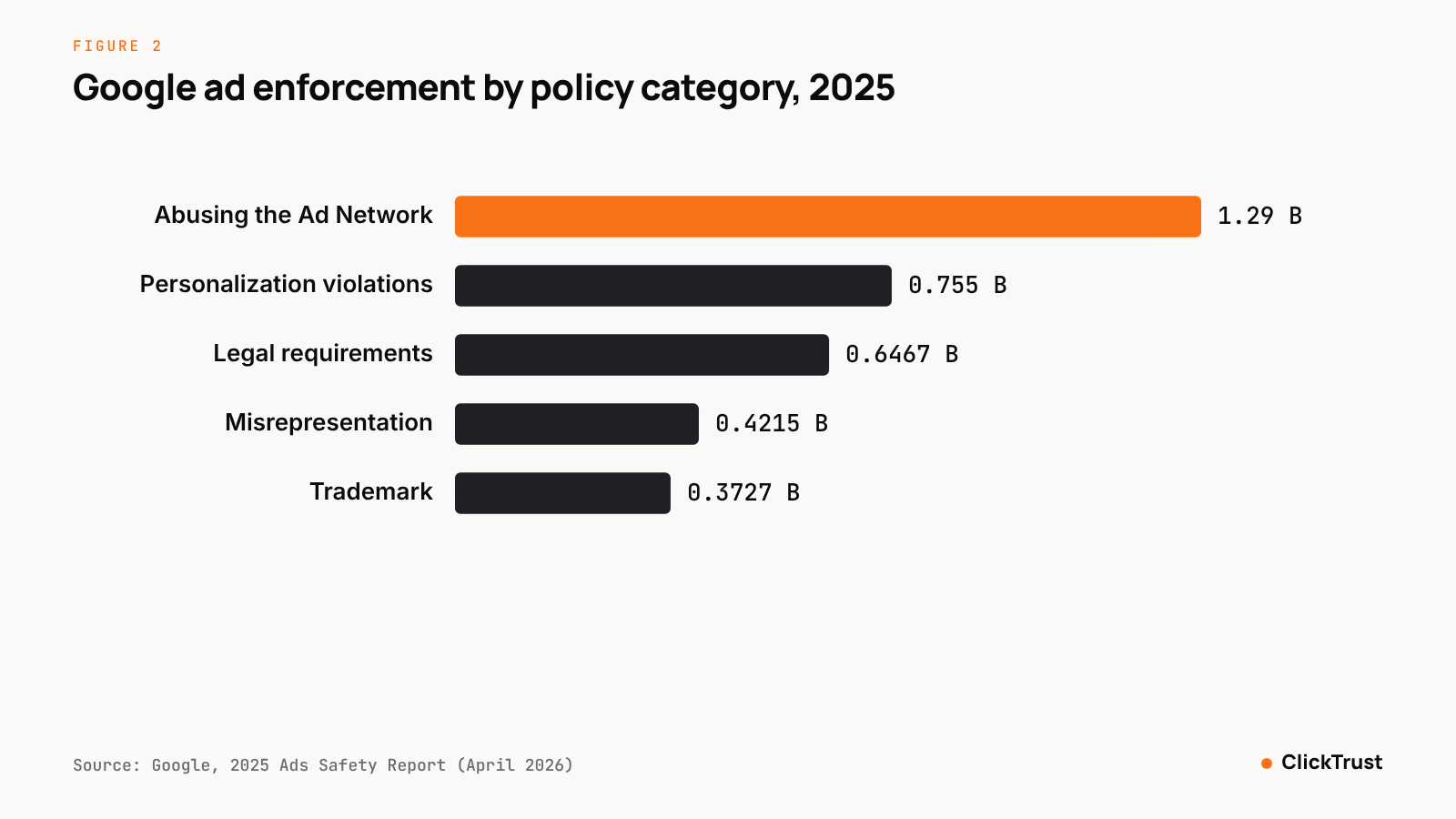 Figure 2. Ads blocked or removed by policy category in 2025, in billions; Abusing the Ad Network was the largest category. Source: Google, 2025 Ads Safety Report.
Publishers
Websites and apps that host display ads earn a share of each click. A dishonest publisher clicks its own ads, or runs scripts that do, to inflate payouts. Google's definition of manual invalid clicks covers this case: clicks made to "inflate publisher profits" (Google, Invalid clicks: Definition).
This is why Display, Video Partner and Search Partner placements deserve closer scrutiny than Search.
Bots and botnets
Automated software now generates more web traffic than humans do. Imperva's 2025 Bad Bot Report found automated traffic reached 51% of all web traffic in 2024, with malicious bots at 37% (Imperva, 2025 Imperva Bad Bot Report). Its Bad Bot Report 2026 put bots above 53% of all web traffic in 2025, with humans down to 47% and 40% of bot traffic classified as malicious (Imperva, Bad Bot Report 2026).
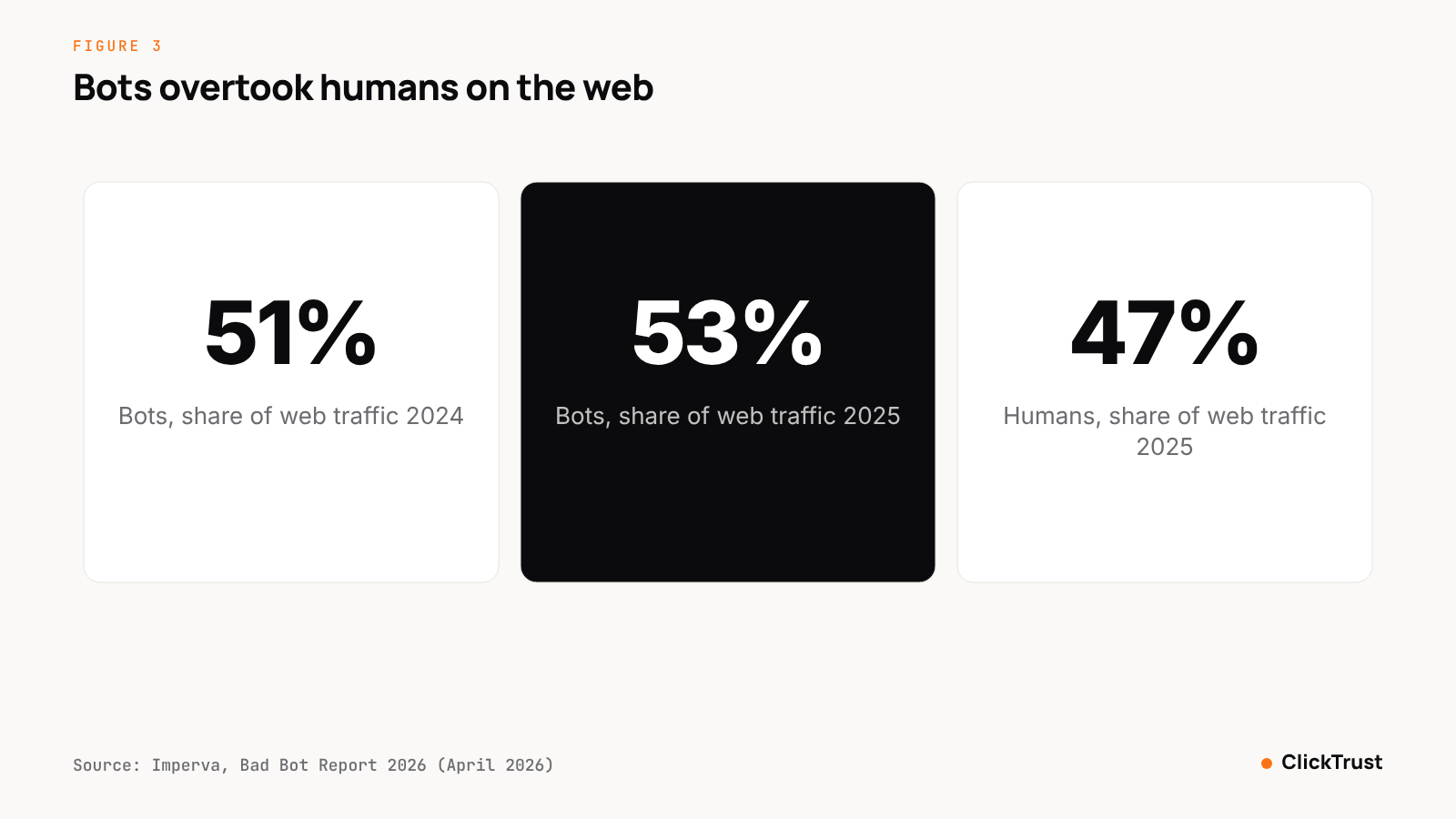 Figure 3. Bots' share of all web traffic passed 50% in 2024 and rose again in 2025. Source: Imperva, Bad Bot Report 2026.
Cloudflare sees the same shift from the network side. By early December 2025, humans generated only 47% of HTML requests on Cloudflare-protected sites, with non-AI bots at 44% (Cloudflare, The 2025 Cloudflare Radar Year in Review). Not every bot is fraud, but every bot that clicks a paid ad is a charge for nothing.
Click farms
Click farms are rooms of people, or racks of phones, paid to click ads, install apps and fill forms. They are hard to catch with IP rules because each click comes from a real device and a real browser. The clearest public measure of their scale is the platforms' own fake-account removals.
Meta reports it took action against 692 million fake accounts on Facebook in Q3 2025 and 1.1 billion in Q4 2025, and estimates fake accounts at about 4% and 5% of worldwide daily active people in those quarters (Meta, Code of Practice on Disinformation report, March 2026). LinkedIn stopped 88.9 million fake accounts at registration between July and December 2025 (LinkedIn, Community Report, H2 2025). On the app side, AppsFlyer's State of Fraud for Marketers 2026 found affiliates generated about 40% of fraudulent installs with a fraud rate near 40% every quarter, against about 1% for self-reporting networks (AppsFlyer, The State of Fraud for Marketers, 2026 Edition).
GIVT and SIVT: the two kinds of invalid traffic
The Media Rating Council (MRC) splits invalid traffic into General Invalid Traffic (GIVT) and Sophisticated Invalid Traffic (SIVT). GIVT is the easy part: known crawlers, declared bots and non-browser traffic that a list can catch. SIVT is the hard part: traffic that looks human and needs behavioral analysis to identify.
The MRC's 2015 guideline defines GIVT as traffic "identified through routine and list-based means of filtration—such as bots, spiders, other crawlers; non-browser user agent headers; and pre-fetch or browser pre-rendered traffic." It defines SIVT as traffic "identified through advanced analytics, multipoint corroboration, human intervention—such as hijacked devices, ad tags, or creative; adware; malware; misappropriated content." (Media Rating Council, Invalid Traffic Detection and Filtration Guidelines Addendum)
The split matters because platforms filter most GIVT before billing, and SIVT is the part you are more likely to pay for. The GIVT vs SIVT explainer goes deeper.
How big is click fraud?
Every serious measurement puts the loss in the tens of billions of dollars a year, but figures depend on method and year, so the table lists each estimate with its date.
| Measure | Figure | Publisher and report | Data period |
|---|---|---|---|
| Share of global digital ad spend lost to ad fraud | 22%, or $84.2 billion, forecast to reach $172.3 billion by 2028 | Juniper Research, Quantifying the cost of ad fraud: 2023-2028 | 2023 |
| Illegitimate desktop clickthroughs | 17% of desktop clickthroughs; 37 billion fraudulent clickthroughs, rising to over 65 billion by 2028 | Juniper Research, same report | 2023 |
| Invalid traffic in unfiltered European video and display channels | 10.36%, against about 1% in TAG-protected channels; €1.19 billion likely lost in unprotected channels | TAG, 2025 European Ad Fraud Savings Report | 2023 |
| Invalid traffic in TAG Certified Channels, US | Under 1% for the fourth consecutive year, across 745 billion impressions | TAG, US Ad Industry Extends Success in Fight Against Fraud | Jan to Jun 2024 |
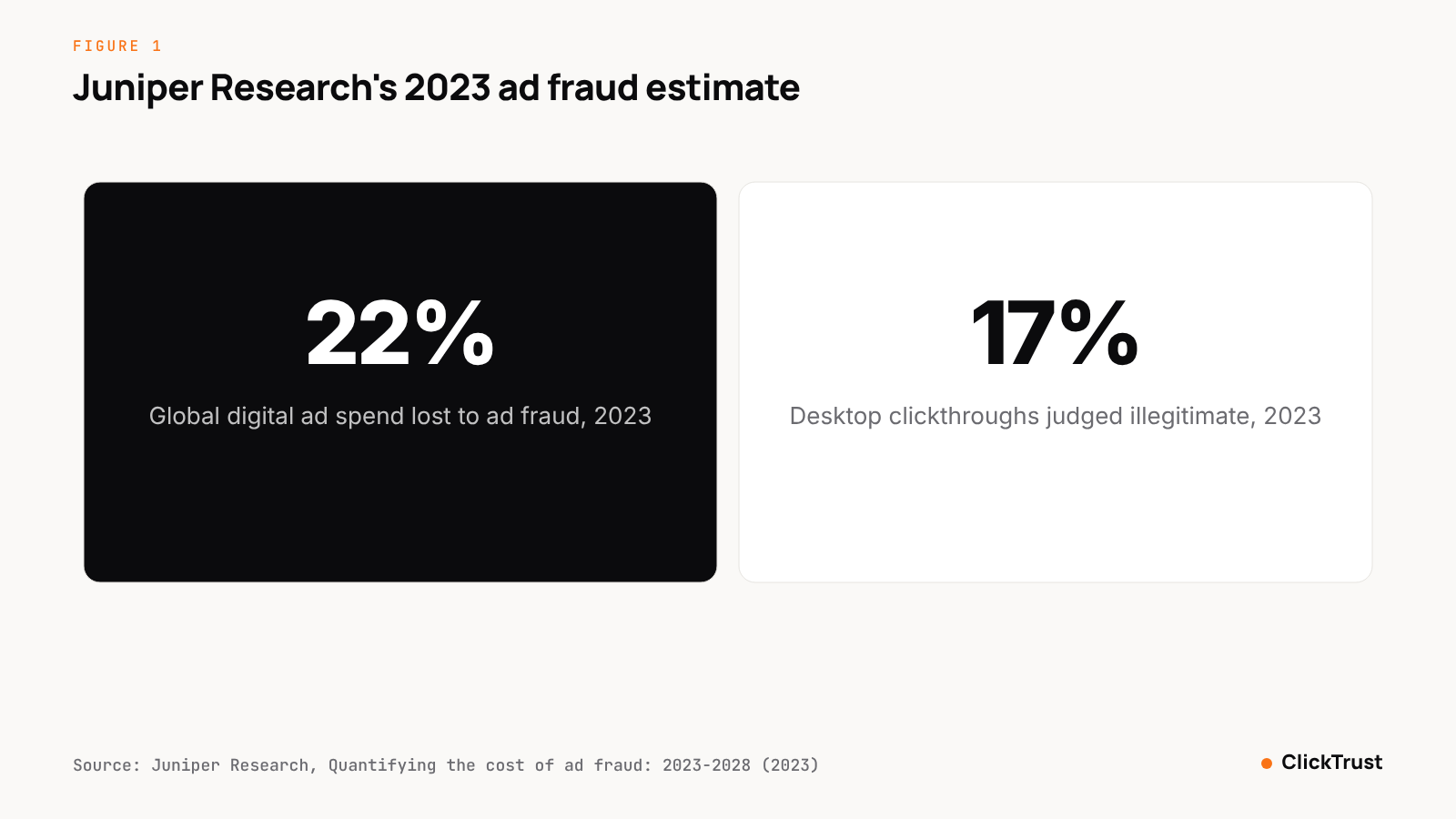 Figure 1. Juniper Research's 2023 estimate of ad fraud's share of global digital ad spend and of illegitimate desktop clickthroughs. Source: Juniper Research, Quantifying the cost of ad fraud: 2023-2028.
Two points stand out. The Juniper Research figures are the most cited, but they are a 2023 estimate and three years old. And TAG's roughly tenfold gap between unfiltered and protected channels shows detection works when it is switched on.
ClickTrust audits find 14 to 42 percent of paid traffic is invalid depending on channel. Our State of Invalid Traffic 2026 report sets out the full picture by platform, region and industry.
How does click fraud show up in Google Ads and Meta reports?
You will not see a column labeled "fraud". You will see symptoms: a clickthrough rate that jumps with no change in conversions, a cost per lead that climbs while lead quality falls, and one-second sessions.
Google Ads filters the invalid clicks it detects out of campaign metrics and billing. One side effect is visible in reports: Google says that "In rare cases, your reports might show more conversions than clicks" when a converting click is later marked invalid (Google, Invalid clicks: Definition). The Invalid traffic card adds two figures, "Estimated savings" for cost saved by automated protections and "Credited cost" for past invalid activity credited after billing (Google, About invalid traffic).
On Meta, the clearest signal is fake accounts. Meta took action against 1 billion fake accounts on Facebook in Q1 2025 and 687 million in Q2 2025, and said fake accounts were about 3% and 4% of worldwide monthly active users in those quarters (Meta, Report September 2025). A fake account that clicks your ad is charged like a real one until Meta catches it. The Google Ads detection guide walks through nine signals to check.
What do the platforms already do about it?
Google removes a great deal of bad activity before it reaches you. It reports it blocked or removed over 8.3 billion ads and suspended 24.9 million advertiser accounts in 2025, and that its systems caught over 99% of policy-violating ads before they served (Google, 2025 Ads Safety Report).
On billing, Google Ads Help states: "You aren't charged for invalid traffic detected before billing", and for activity found later "you'll receive credits in the form of a billing adjustment for the value of the invalid activity" (Google, About invalid traffic). On November 12, 2026 Google added an Invalid Traffic Overview Card to Google Ads showing the amount saved and the credits issued (Google, We're introducing a new transparency tool for invalid traffic in Google Ads).
Meta says it removed over 159 million scam ads in 2025, 92% of them before anyone reported them (Meta, Integrity Reports, H1 2026). What the platforms do not publish is what they missed. None of them reports a miss rate. TAG's European data, with 10.36% invalid traffic in unfiltered channels and about 1% in protected ones, is the closest public measure of how much depends on whether a filter is in place (TAG, 2025 European Ad Fraud Savings Report).
How do you detect click fraud?
Detection means comparing what the platform charged you for with what actually arrived on your site.
- Export click-level data from Google Ads with timestamp, device, placement and location, and match it to your analytics sessions and server logs.
- Look for repeated IP addresses, data-center ranges and clusters of clicks at odd hours for your market.
- Compare clickthrough, bounce and conversion rates by placement and campaign type, isolating Display, Video Partners and Search Partners.
- Check geography: clicks from countries you do not target, or from a city with no customers, deserve a closer look.
- Segment by device and browser, and flag any combination that drives many clicks and no conversions.
- Add exclusions for bad IP addresses, placements and locations, then re-measure over the next billing cycle.
How do you stop click fraud?
Prevention has three parts: exclusion, detection and evidence. Start with Google's own controls: IP exclusions, placement exclusions and tighter location targeting. Then add a detection layer that labels each click valid, GIVT or SIVT, pushes exclusions back to the ad platform and keeps a log you can attach to a claim.
How ClickTrust helps
ClickTrust's Web Protection layer runs 320 detection traps, each labeled GIVT or SIVT in line with MRC invalid-traffic guidance, scores every event in under 50 milliseconds and assigns one fraud score per event, the Traffic Quality Index (TQI). It pushes IP and audience exclusions to Google Ads, Meta and Bing automatically and produces refund-ready evidence packs. It is free to start, and Traffic Rx gives you a free landing-page traffic diagnosis before you commit.
Sources
- Google, Google Ad Traffic Quality (undated, fetched November 2026), https://www.google.com/ads/adtrafficquality/
- Google, About invalid traffic, Google Ads Help (undated, fetched November 2026), https://support.google.com/google-ads/answer/2549113
- Google, Invalid clicks: Definition, Google Ads Help (undated, fetched November 2026), https://support.google.com/google-ads/answer/42995
- Google, Abusing the ad network, Advertising Policies Help (undated), https://support.google.com/adspolicy/answer/6020954
- Google, 2025 Ads Safety Report (April 2026), https://services.google.com/fh/files/blogs/global_2025_adssafetyreport.pdf
- Imperva, 2025 Imperva Bad Bot Report: How AI is Supercharging the Bot Threat (April 2025), https://www.imperva.com/blog/2025-imperva-bad-bot-report-how-ai-is-supercharging-the-bot-threat/
- Imperva, Bad Bot Report 2026: Bots in the Agentic Age (April 2026), https://www.imperva.com/blog/bad-bot-report-2026-bots-agentic-age/
- Cloudflare, The 2025 Cloudflare Radar Year in Review (December 2025), https://blog.cloudflare.com/radar-2025-year-in-review/
- Meta, Code of Practice on Disinformation report, March 2026 (March 2026), https://www.disinfocode.eu/reports/meta/8
- LinkedIn, Community Report, H2 2025 (2026), https://about.linkedin.com/transparency/community-report
- AppsFlyer, The State of Fraud for Marketers, 2026 Edition (April 2026), https://www.appsflyer.com/resources/reports/state-fraud-marketers-report/
- Media Rating Council, Media Rating Council (MRC) Issues Final Version Of Invalid Traffic Detection And Filtration Guidelines Addendum (October 27, 2015), https://prnewswire.com/news-releases/media-rating-council-mrc-issues-final-version-of-invalid-traffic-detection-and-filtration-guidelines-addendum-300166843.html
- Google, About invalid traffic, Google Ads Help (undated, fetched November 2026), https://support.google.com/google-ads/answer/11182074?hl=en
- Juniper Research, Quantifying the cost of ad fraud: 2023-2028 (2023), https://www.juniperresearch.com/
- TAG, 2025 European Ad Fraud Savings Report (2025), https://ppc.land/content/files/2025/06/2025_TAG_EuropeanFraudSavingsReport-Final-compressed.pdf
- TAG, US Ad Industry Extends Success in Fight Against Fraud with Fourth Straight Year of Sub-1% IVT in TAG Certified Channels (October 29, 2024), https://www.tagtoday.net/pressreleases/us-ad-industry-extends-success-in-fight-against-fraud-with-fourth-straight-year-of-sub-1-ivt-in-tag-certified-channels
- Meta, Report September 2025, Code of Practice on Disinformation (September 2025), https://www.disinfocode.eu/reports/meta/6
- Google, Gemini is stopping harmful ads before people ever see them, 2025 Ads Safety Report (April 2026), https://blog.google/products/ads-commerce/2025-ads-safety-report/
- Google, We're introducing a new transparency tool for invalid traffic in Google Ads (November 12, 2026), https://blog.google/products/ads-commerce/invalid-traffic-overview-google-ads/
- Meta, Integrity Reports, H1 2026 (March 2026), https://transparency.meta.com/reports/integrity-reports-h1-2026/
Frequently asked questions
What is click fraud in simple terms?
Click fraud is when someone or something clicks a pay-per-click ad with no intention of buying, so the advertiser pays for a worthless click. The clicker can be a bot, a paid click farm, a competitor trying to drain your budget, or a publisher inflating its own ad revenue. Google calls the wider category invalid traffic.
Is click fraud illegal?
It depends on the jurisdiction and the actor, and most cases are handled under platform policy rather than in court. Google's advertising policy prohibits using the Google Network to gain an unfair traffic advantage over other participants in the auction, and it suspends accounts that break the rule. Advertisers usually pursue refunds and exclusions rather than lawsuits.
How much does click fraud cost advertisers?
No current figure is beyond dispute. Juniper Research's 2023 whitepaper put total ad fraud at 22% of global digital spend, or $84.2 billion, rising to $172.3 billion by 2028. TAG's 2025 European Ad Fraud Savings Report measured 10.36% invalid traffic in unfiltered channels in 2023. ClickTrust audits typically find 14 to 42 percent of paid traffic is invalid depending on channel.
Does Google refund click fraud?
Partly. Google Ads Help says you are not charged for invalid traffic detected before billing, and that activity found later is credited as a billing adjustment. You can ask Google to review the last 60 days through the Click Quality Form. Clicks that Google's filters miss are not refunded unless you can show evidence.
What is the difference between click fraud and invalid traffic?
Invalid traffic is the wider term the Media Rating Council and Google use for any click or impression that does not represent genuine interest, including accidental clicks and declared crawlers. Click fraud is the deliberate part: bots, click farms, competitor clicks and publisher self-clicking. All click fraud is invalid traffic, but not all invalid traffic is fraud.