Invalid Traffic Explained: GIVT vs SIVT and Who Pays (2026)
ClickTrust Research · · 10 min read · invalid traffic · GIVT · SIVT · MRC · google ads · click fraud
TL;DR Invalid traffic is any ad activity that does not come from a real person with real interest, and the Media Rating Council splits it into General Invalid Traffic, which routine lists catch, and Sophisticated Invalid Traffic, which needs advanced analytics. Google says it does not charge for invalid traffic it detects, but no platform publishes a miss rate, and TAG's data shows unfiltered channels run about ten times the invalid rate of protected ones.
Key takeaways
- The MRC defines GIVT as traffic identified through routine and list-based filtration, such as bots, spiders, crawlers and non-browser user agents, and SIVT as traffic that needs advanced analytics, multipoint corroboration or human intervention.
- TAG's 2025 European Ad Fraud Savings Report estimated 10.36% invalid traffic in unfiltered channels in 2023 against about 1% in TAG-protected channels, a measure of what certified filtering removes.
- Google Ads Help states that advertisers are not charged for invalid traffic detected before billing and receive a billing adjustment for activity detected afterwards.
- Cloudflare found AI crawlers generated 20% of verified bot traffic in 2025, half the 40% from search engine crawlers, and both belong in GIVT because they declare themselves.
- AppsFlyer's State of Fraud for Marketers 2026 found fake installs were 87% of detected Android fraud and 92% of iOS fraud, the in-app face of SIVT.
- Evidence labeled by MRC category turns a refund request from an opinion into a dataset the platform can verify against its own definitions.
Invalid traffic is any click, impression or interaction on an ad that does not come from a real person with real interest, including bots, crawlers, accidental clicks and deliberate fraud. The Media Rating Council (MRC) splits it into two tiers: General Invalid Traffic (GIVT), which routine lists catch, and Sophisticated Invalid Traffic (SIVT), which needs advanced analytics to find.
The split sounds academic until you look at a bill. Platforms filter most GIVT for free. SIVT is the part that reaches your invoice. This explainer gives the verbatim MRC definitions, a side-by-side comparison, Google's exact wording on what it charges for, and how MRC-labeled evidence changes a refund conversation.
What is invalid traffic, according to the MRC?
The MRC's own definition is broad on purpose. In its June 2020 update to the Invalid Traffic Detection and Filtration Standards, the MRC wrote: "The MRC defines Invalid Traffic generally as traffic or associated media activity that does not meet certain quality or completeness criteria, or otherwise does not represent legitimate traffic that should be included in measurement counts. Among the reasons why traffic may be deemed invalid is that it is a result of non-human traffic (spiders, bots, etc.), or activity designed to produce IVT." (Media Rating Council, Media Rating Council Issues Update To Invalid Traffic Detection And Filtration Standards)
The Trustworthy Accountability Group (TAG), which certifies the buying chain against fraud, uses the same definition and notes that the MRC addendum "separates IVT into two categories", GIVT and SIVT (TAG, 2025 European Ad Fraud Savings Report).
Google's definition is shorter and advertiser-facing. Google Ads Help says: "Invalid traffic refers to traffic that doesn't represent genuine interest in your business" (Google, About invalid traffic, Google Ads Help). Google's Ad Traffic Quality page adds: "In a nutshell, it's any interaction that doesn't come from real people with real interest in an ad" (Google, Google Ad Traffic Quality).
Neither definition mentions intent. Click fraud is the deliberate subset, which our click fraud explainer covers.
What is GIVT?
General Invalid Traffic is invalid traffic that a routine, list-based check can identify. The MRC's October 2015 guideline addendum defines it as follows: "General Invalid Traffic (GIVT): Includes traffic identified through routine and list-based means of filtration—such as bots, spiders, other crawlers; non-browser user agent headers; and pre-fetch or browser pre-rendered traffic." (Media Rating Council, Invalid Traffic Detection and Filtration Guidelines Addendum)
In practice, GIVT announces itself: a crawler's user-agent string, a data-center IP range on a published list, a pre-rendered page nobody saw. The lists are large. TAG's Data Center IP list grew to nearly 68 million IP addresses in 2025 (TAG, 2025 TAG Analysis Shows Ad Industry Progress in Fighting Fraud).
GIVT is growing because of AI crawlers, which declare themselves and so fall on the list side of the line. Cloudflare's 2025 Radar Year in Review found search engine crawlers generated 40% of verified bot traffic and AI crawlers half as much, 20% (Cloudflare, The 2025 Cloudflare Radar Year in Review).
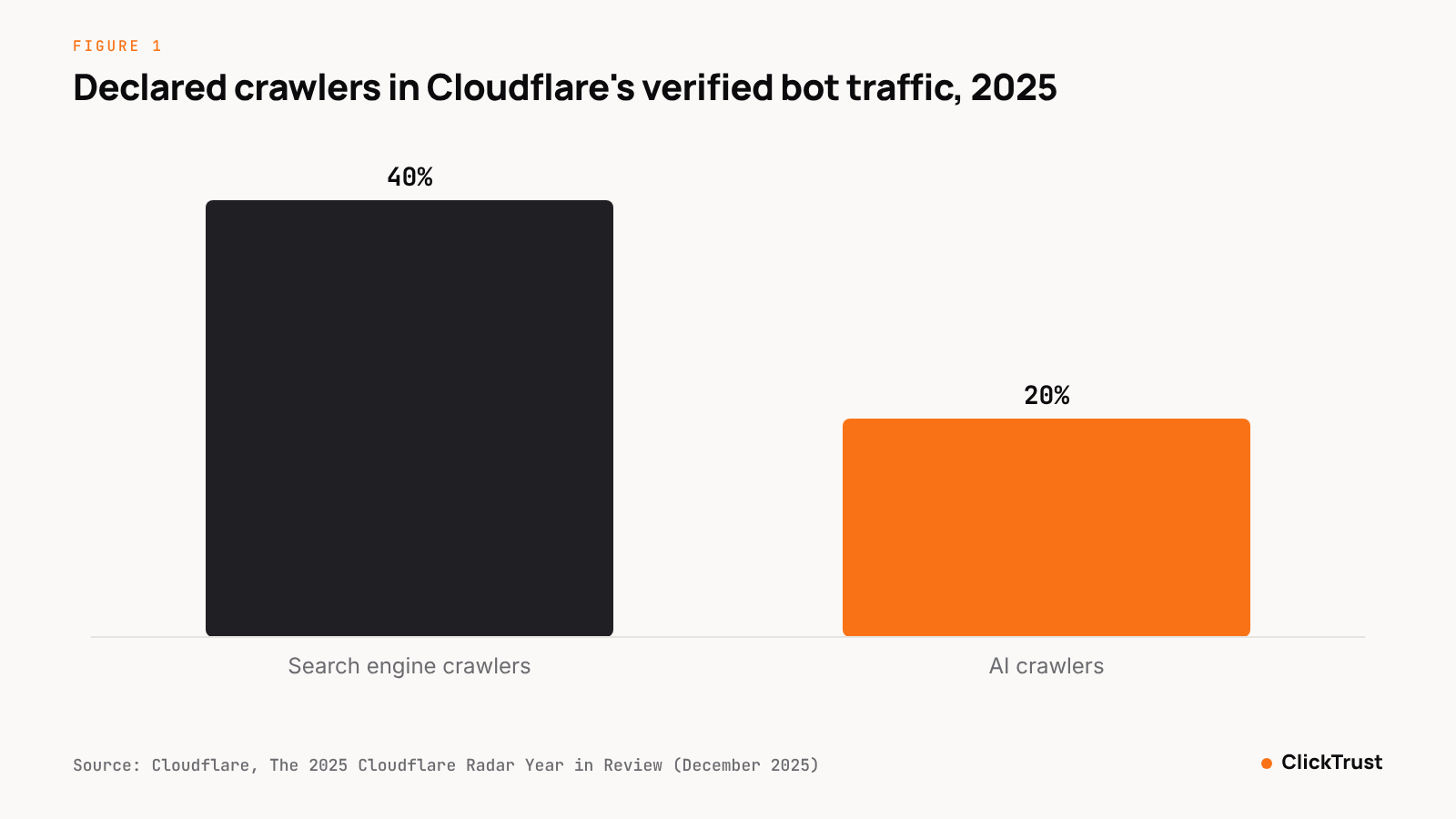 Figure 1. Search engine and AI crawlers declare themselves, which puts them in GIVT; AI crawlers were half the size of search crawlers in 2025. Source: Cloudflare, The 2025 Cloudflare Radar Year in Review.
What is SIVT?
Sophisticated Invalid Traffic is invalid traffic that looks legitimate and needs analysis to expose. The same MRC addendum defines it: "Sophisticated Invalid Traffic (SIVT): Includes traffic identified through advanced analytics, multipoint corroboration, human intervention—such as hijacked devices, ad tags, or creative; adware; malware; misappropriated content." (Media Rating Council, Invalid Traffic Detection and Filtration Guidelines Addendum)
The MRC's 2020 update tightened the SIVT side. It added "more specific Sophisticated Invalid Traffic (SIVT) areas", a required "decision rate" metric, and formal requirements for machine learning and human intervention in detection (Media Rating Council, June 2020 update). A vendor claiming SIVT detection to MRC standards has to show how often it reaches a decision, not only how many clicks it blocks.
In-app advertising shows the shape of SIVT most clearly. AppsFlyer's State of Fraud for Marketers 2026 found fake installs made up 87% of detected Android fraud and 92% of iOS fraud, and that physical device farms grew 72% year over year in Android gaming while emulators fell 32% (AppsFlyer, The State of Fraud for Marketers, 2026 Edition). Fraudsters moved from emulators, which lists and device checks catch, to real hardware, which they do not. Our In-App Protection page covers that channel.
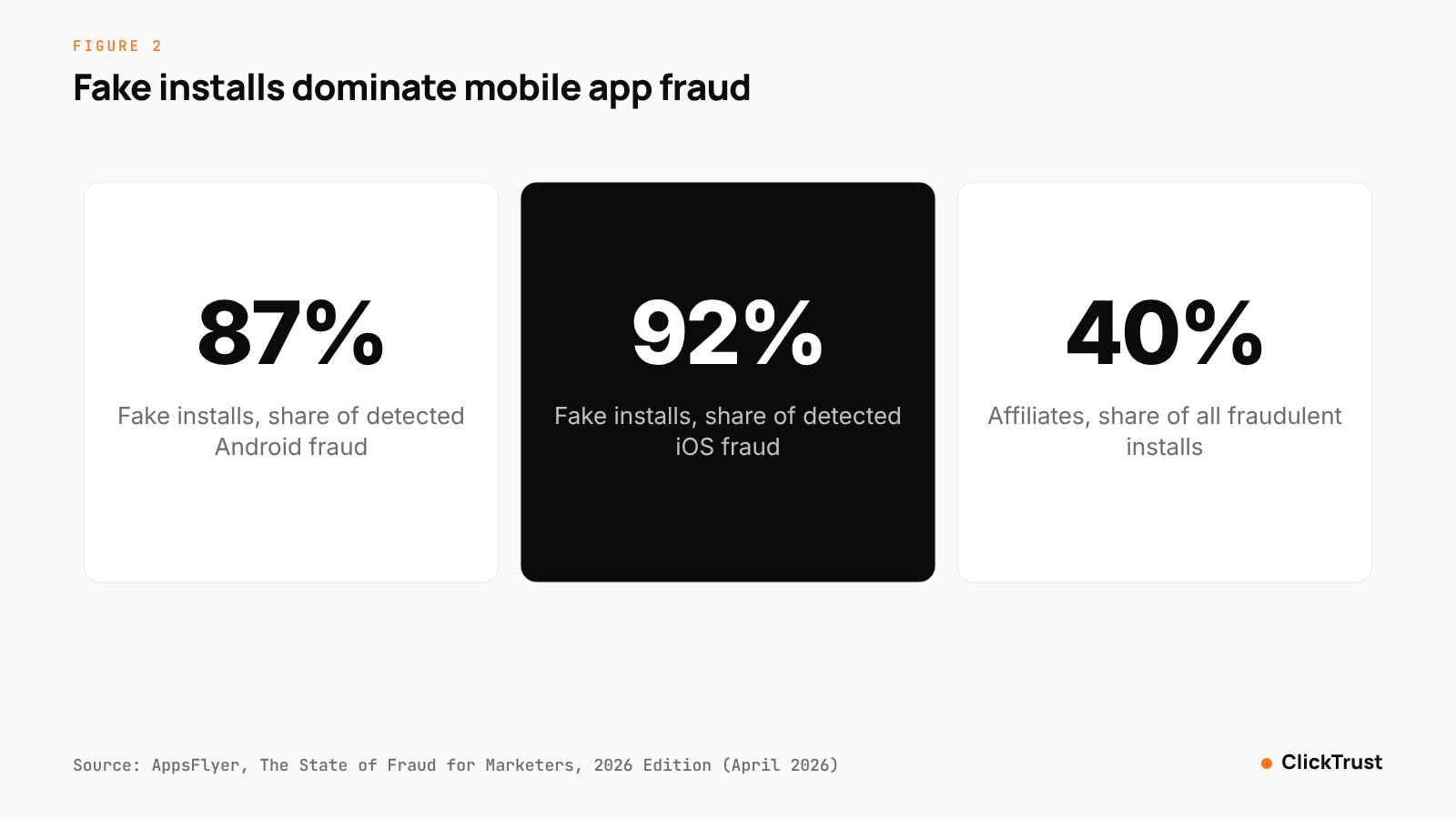 Figure 2. Fake installs were the bulk of detected install fraud on both platforms, and affiliates generated about 40% of fraudulent installs. Source: AppsFlyer, The State of Fraud for Marketers, 2026 Edition.
GIVT vs SIVT: comparison table
| GIVT (General Invalid Traffic) | SIVT (Sophisticated Invalid Traffic) | |
|---|---|---|
| What it is | Traffic identified through routine and list-based filtration (MRC) | Traffic identified through advanced analytics, multipoint corroboration or human intervention (MRC) |
| Examples | Declared bots, spiders and crawlers; non-browser user agents; pre-fetch and pre-rendered traffic; known data-center IP ranges | Bots masquerading as users; hijacked devices and sessions; adware and malware; proxy traffic; device farms; click farms; manual competitor clicks |
| How it is detected | Matching against published bot and spider lists, user-agent checks, data-center IP lists | Behavioral analysis across many signals per event, cross-referencing of device, network and session data, machine learning, human review |
| Who filters it | Ad platforms, before billing in most cases; any analytics tool with a bot filter | Platform fraud teams for the cases they catch; MRC-accredited verification; specialist click-fraud tools on the advertiser side |
| Scale indicators | TAG's data-center list: nearly 68 million IPs; AI crawlers: 20% of Cloudflare's verified bot traffic | 40% of all bot traffic malicious (Imperva); fake installs 87% of Android fraud (AppsFlyer) |
| Who usually pays | Rarely the advertiser | Often the advertiser, until it is detected and credited |
What does Google say it charges for?
Google's position is clear: it does not charge for invalid traffic it detects. Google Ads Help states: "You aren't charged for invalid traffic detected before billing." For activity found later, it says "you'll receive credits in the form of a billing adjustment for the value of the invalid activity." It adds that investigations cover the last 60 days and that "To submit your request, use the Click Quality Form." (Google, About invalid traffic, Google Ads Help)
The invalid-clicks page is just as direct: "You won't be charged for invalid clicks or impressions" (Google, Invalid clicks: Definition, Google Ads Help).
Google's own reporting mirrors the MRC's two tiers. Its Invalid traffic card defines "Estimated savings" as "The estimated cost saved by automated protections from invalid traffic", covering automated filters plus proactive manual reviews, and "Credited cost" as "The amount credited back to you for past invalid activity detected after the billing period ended" (Google, About invalid traffic, Google Ads Help). Automated filters are the list side; manual reviews are the MRC's "human intervention". On November 12, 2026, Google added an Invalid Traffic Overview Card to Google Ads and repeated the principle: "We don't charge for invalid traffic" (Google, We're introducing a new transparency tool for invalid traffic in Google Ads).
Every statement covers invalid traffic Google detects. None promises Google detects all of it, and no platform publishes a miss rate.
Why is SIVT the part advertisers still pay for?
Because SIVT is designed to pass the checks that catch GIVT. A declared crawler is filtered before billing. A bot on a residential IP address, in a real Chrome build, that scrolls and pauses like a person, is not on any list. It reaches the auction, wins the click, and lands on your page.
Three findings show the gap. First, the size of the pool. Imperva's Bad Bot Report 2026 found bots were more than 53% of all web traffic in 2025, humans 47%, and 40% of bot traffic malicious, with AI-driven bot attacks up 12.5 times in a year (Imperva, Bad Bot Report 2026).
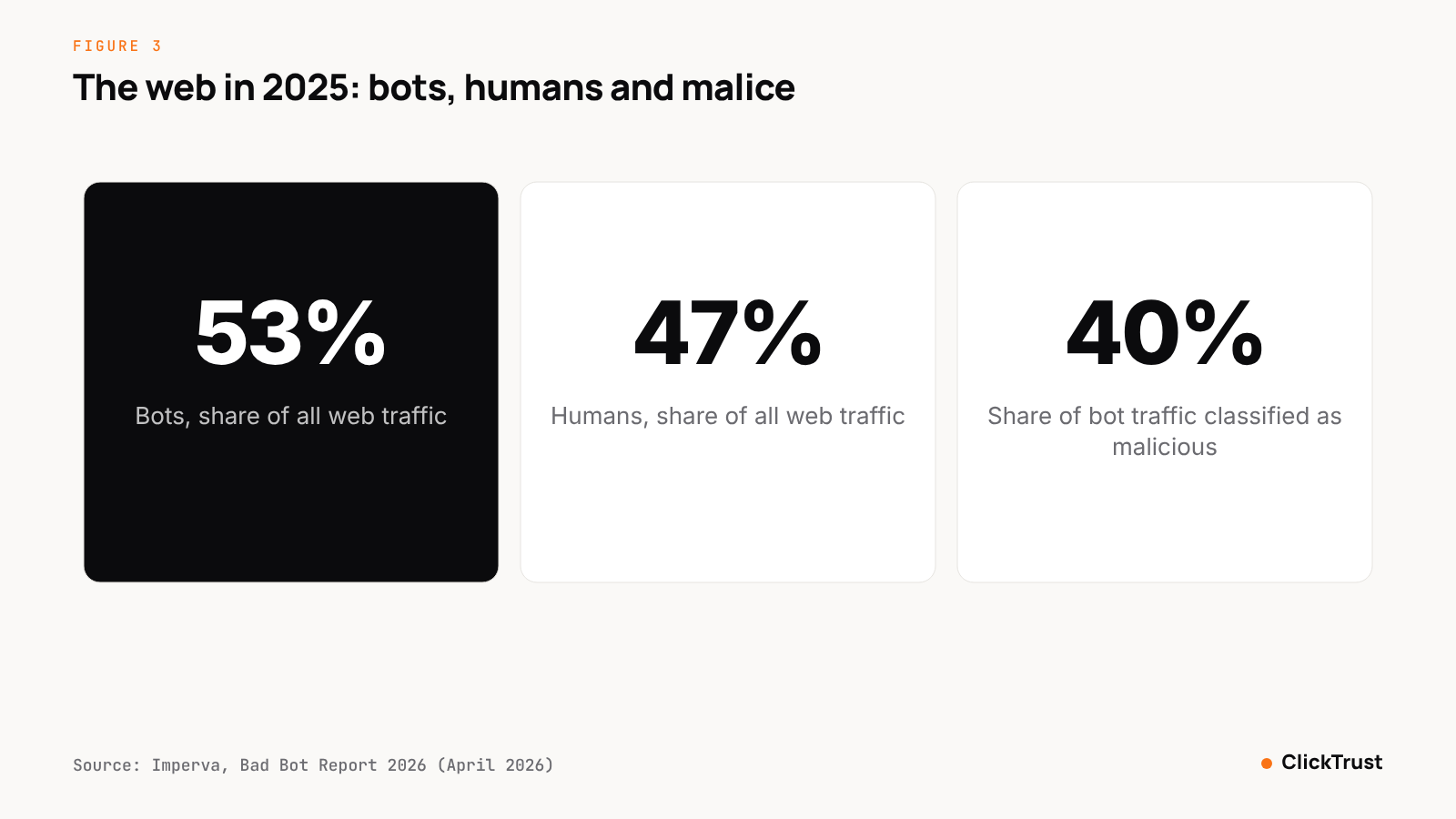 Figure 3. Bots passed humans on the web in 2025, and two in five bot requests were malicious. Source: Imperva, Bad Bot Report 2026.
Second, what filtering achieves when it is in place. Invalid traffic held under 1% in TAG Certified Channels in the US for the fourth consecutive year, across 745 billion impressions, where "the agency, buying platform, and selling platform involved in a transaction are all Certified Against Fraud" (TAG, US Ad Industry Extends Success in Fight Against Fraud).
Third, what reaches advertisers without it. TAG's 2025 European Ad Fraud Savings Report estimated a 10.36% invalid traffic rate in unfiltered video and display channels in 2023, against about 1% in protected channels, and put the likely loss in unprotected channels at €1.19 billion, "more than 10x the relative level of IVT losses as those in Protected Channels" (TAG, 2025 European Ad Fraud Savings Report). The distance between those two rates is the traffic that reaches advertisers who run no detection of their own, and most of it is the sophisticated kind.
ClickTrust audits find 14 to 42 percent of paid traffic is invalid depending on channel. The wider context is in our State of Invalid Traffic 2026 report.
How does MRC-labeled evidence change a refund conversation?
A refund request that says "we think these clicks were fake" is an opinion. A request that says "these 4,312 clicks match the MRC SIVT category for invalid proxy traffic, here are the IP addresses, timestamps, user agents and the zero conversions that followed" is a dataset the platform can check against its own definitions.
Labeling matters for three reasons. The platform's fraud team speaks in MRC terms. GIVT-labeled clicks should already have been filtered, so any GIVT on your bill is a clear-cut credit request. SIVT-labeled clicks need the corroboration the MRC describes, so show several signals per click, not one.
Google's Click Quality Form accepts investigation requests for "invalid clicks, poor-quality form submissions, clicks outside location targeting, or sudden short-term cost increases" (Google, About the Invalid Activity Credit Report), for "activity within the last 60 days" (Google, About invalid traffic). Build the evidence this way.
- Export the suspect clicks with timestamp, IP address, user agent, placement, device and location, and match each to the landing-page session or its absence.
- Assign each click an MRC category: GIVT for list-based matches such as data-center ranges and known bot user agents, SIVT for behavioral matches such as impossible session timing, proxy signatures or repeat devices across rotated IP addresses.
- Summarize the conversion gap: clicks, sessions, conversions and cost for the flagged set against the clean set over the same period.
- Submit within Google's 60-day window through the Click Quality Form, and keep the file for the next request.
The Google Ads refund checklist takes you through the submission itself.
How ClickTrust helps
ClickTrust labels every event GIVT or SIVT in line with MRC invalid-traffic guidance. Its Web Protection layer runs 320 detection traps, scores each event in under 50 milliseconds and assigns a single Traffic Quality Index (TQI) score. Exclusions are pushed to Google Ads, Meta and Bing automatically, and refund-ready evidence packs carry the MRC labels, IP lists and timestamps a Click Quality Form request needs.
It is free to start. If you want to see how your current protection performs against the SIVT share before you commit, the fraud evaluation is the place to begin.
Sources
- Media Rating Council, Media Rating Council Issues Update To Invalid Traffic Detection And Filtration Standards (June 25, 2020), https://www.mediaratingcouncil.org/sites/default/files/News/General-Announcements/062520%20Media%20Rating%20Council%20Issues%20Update%20To%20Invalid%20Traffic%20Detection%20and%20Filtration%20Standards_Final.pdf
- TAG, 2025 European Ad Fraud Savings Report (2025), https://ppc.land/content/files/2025/06/2025_TAG_EuropeanFraudSavingsReport-Final-compressed.pdf
- Google, About invalid traffic, Google Ads Help (undated, fetched November 2026), https://support.google.com/google-ads/answer/2549113
- Google, Google Ad Traffic Quality (undated, fetched November 2026), https://www.google.com/ads/adtrafficquality/
- Media Rating Council, Media Rating Council (MRC) Issues Final Version Of Invalid Traffic Detection And Filtration Guidelines Addendum (October 27, 2015), https://prnewswire.com/news-releases/media-rating-council-mrc-issues-final-version-of-invalid-traffic-detection-and-filtration-guidelines-addendum-300166843.html
- TAG, 2025 TAG Analysis Shows Ad Industry Progress in Fighting Fraud, Sharing Threats and Improving Transparency (February 3, 2026), https://www.tagtoday.net/pressreleases/2025-tag-analysis-shows-ad-industry-progress-in-fighting-fraud-sharing-threats-and-improving-transparency
- Cloudflare, The 2025 Cloudflare Radar Year in Review (December 2025), https://blog.cloudflare.com/radar-2025-year-in-review/
- Google, Invalid clicks: Definition, Google Ads Help (undated, fetched November 2026), https://support.google.com/google-ads/answer/42995
- AppsFlyer, The State of Fraud for Marketers, 2026 Edition (April 2026), https://www.appsflyer.com/resources/reports/state-fraud-marketers-report/
- Google, About invalid traffic, Google Ads Help (undated, fetched November 2026), https://support.google.com/google-ads/answer/11182074?hl=en
- Google, We're introducing a new transparency tool for invalid traffic in Google Ads (November 12, 2026), https://blog.google/products/ads-commerce/invalid-traffic-overview-google-ads/
- Imperva, Bad Bot Report 2026: Bots in the Agentic Age (April 2026), https://www.imperva.com/blog/bad-bot-report-2026-bots-agentic-age/
- TAG, US Ad Industry Extends Success in Fight Against Fraud with Fourth Straight Year of Sub-1% IVT in TAG Certified Channels (October 29, 2024), https://www.tagtoday.net/pressreleases/us-ad-industry-extends-success-in-fight-against-fraud-with-fourth-straight-year-of-sub-1-ivt-in-tag-certified-channels
- Google, About the Invalid Activity Credit Report, Google Ads Help (2026), https://support.google.com/google-ads/answer/16826168?hl=en
Frequently asked questions
What is invalid traffic in advertising?
The Media Rating Council defines invalid traffic as traffic or associated media activity that does not meet certain quality or completeness criteria, or otherwise does not represent legitimate traffic that should be included in measurement counts. Google Ads Help puts it as traffic that does not represent genuine interest in your business. Both cover bots, accidental clicks and deliberate fraud.
What is the difference between GIVT and SIVT?
GIVT, General Invalid Traffic, is caught by routine, list-based filtering: known bots, spiders, crawlers, non-browser user agents and pre-fetch traffic. SIVT, Sophisticated Invalid Traffic, needs advanced analytics, multipoint corroboration or human intervention to identify, and includes hijacked devices, adware, malware and bots that mimic real users. The difference is how hard it is to detect, not how much it costs.
Does Google charge for invalid traffic?
Google says it does not charge for invalid traffic it detects. Google Ads Help states you are not charged for invalid traffic detected before billing and receive a billing adjustment for activity detected afterwards, and its Invalid traffic card reports Estimated savings and Credited cost. The gap is traffic Google does not detect, and no platform publishes a miss rate.
Is all invalid traffic fraud?
No. Google's Ad Traffic Quality page notes that some invalid traffic is accidental, such as a badly placed ad that gets in the way of something the user is trying to click, while some is deliberate, such as botnets or competitors clicking to waste budgets. Declared crawlers in GIVT are not fraud either. Fraud is the deliberate subset.
Why does SIVT matter more than GIVT for advertisers?
Because platforms filter most GIVT before billing, SIVT is the part you are more likely to pay for. SIVT uses real browsers, residential IP addresses and human-like behavior, so it passes the list-based checks and reaches your bill. The MRC says it needs advanced analytics, multipoint corroboration or human intervention to identify, which means behavioral analysis of each click rather than a lookup.