Click Fraud in India 2026: Rates, Sectors and What to Do
ClickTrust Research · · 11 min read · click fraud · India · invalid traffic · iGaming · fintech · edtech
TL;DR India's digital ad market reached Rs 71,621 crore in 2025 and became the country's largest advertising channel, and the invalid traffic on it concentrates in the channels that grew fastest: in-app, affiliate, programmatic and retail media. India accounts for nearly 28% of global Android install fraud, affiliates supply 65% of it, and gambling, fintech and e-commerce advertisers are the most exposed.

Key takeaways
- Digital became India's largest ad channel in 2025 at Rs 71,621 crore, 59% of all ad spend according to dentsu-e4m, and FICCI-EY puts digital at INR 947 billion, or 63% of ad revenue.
- Programmatic was 42% of India's digital spend at Rs 30,081 crore and e-retail media grew 55.86% to Rs 17,601 crore, the two lines bought at the greatest scale with the least scrutiny.
- India accounts for nearly 28% of all global Android install fraud according to AppsFlyer, and the affiliate share of India's install fraud rose from 57% to 65% in a year.
- Financial cyber-fraud complaints on India's national portal rose from 6,94,446 in 2022 to 24,02,579 in 2025, with reported losses of Rs 22,495 crore in 2025 alone, according to the Ministry of Home Affairs.
- Google blocked or removed 483.7 million ads and suspended 1.7 million advertiser accounts in India in 2025, while globally its largest enforcement category was Abusing the Ad Network at more than 1.29 billion ads.
- TAG measured invalid traffic at about 1% in certified channels against 10.36% in unfiltered ones, and ANA case studies show nearly 40% reductions in cost per conversion when buyers optimize to quality-adjusted metrics.
How much click fraud is there in India?
India's digital ad market reached Rs 71,621 crore in 2025 and became the country's largest advertising channel, and the checkable evidence on click fraud in India points to the channels that grew fastest: in-app, affiliate, programmatic and retail media. AppsFlyer puts India at nearly 28% of all global Android install fraud, with affiliates supplying 65% of it (AppsFlyer). This post sets out the click fraud in India picture from publishers whose figures can be verified, shows where the invalid traffic enters, and lays out what to do about it.
Click fraud in India is the share of paid clicks, installs and impressions bought by Indian advertisers that comes from bots, click farms, hijacked devices and other sources with no genuine interest in the ad, rather than from real prospective customers. The Media Rating Council splits invalid traffic into general invalid traffic, identified through routine, list-based filtration, and sophisticated invalid traffic, which needs advanced analytics, multipoint corroboration and human intervention (MRC).
How big is India's digital ad market?
Digital became India's largest advertising channel in 2025. According to the dentsu-e4m Digital Advertising Report 2026, as reported by Social Samosa, digital ad spend reached Rs 71,621 crore in 2025, up 19%, which is 59% of a total ad market of Rs 1,21,339 crore; dentsu projects Rs 98,034 crore and a 70% share by 2027 (Social Samosa). The FICCI-EY report, published by EY India, puts digital advertising at INR 947 billion in 2025, up 26%, or 63% of total ad revenue (EY India).
| Publisher and report | Measure | Figure |
|---|---|---|
| dentsu-e4m, Digital Advertising Report 2026 | Digital ad spend, 2025 | Rs 71,621 crore, 59% of total, up 19% |
| FICCI-EY, media and entertainment report | Digital ad revenue, 2025 | INR 947 billion, 63% of total, up 26% |
| WPP Media, This Year Next Year India | Total ad revenue forecast, 2026 | Rs 2,01,891 crore, digital 68.1% |
| WPP Media, This Year Next Year India mid-year | Total ad revenue, revised 2026 | $22.5 billion, growth cut to 8.8% |
Sources: Social Samosa reporting dentsu-e4m; EY India; Social Samosa reporting WPP Media; WPP Media.
Within the digital total, the same dentsu-e4m report puts programmatic at Rs 30,081 crore (42% of digital), social media at Rs 21,057 crore, online video at Rs 20,004 crore, paid search at Rs 16,581 crore and e-retail media at Rs 17,601 crore, the fastest-growing line at 55.86% year on year (Social Samosa). FICCI-EY reports e-commerce and point-of-sale ads up 50% to INR 220 billion and SME and long-tail digital ads at INR 363 billion (EY India).
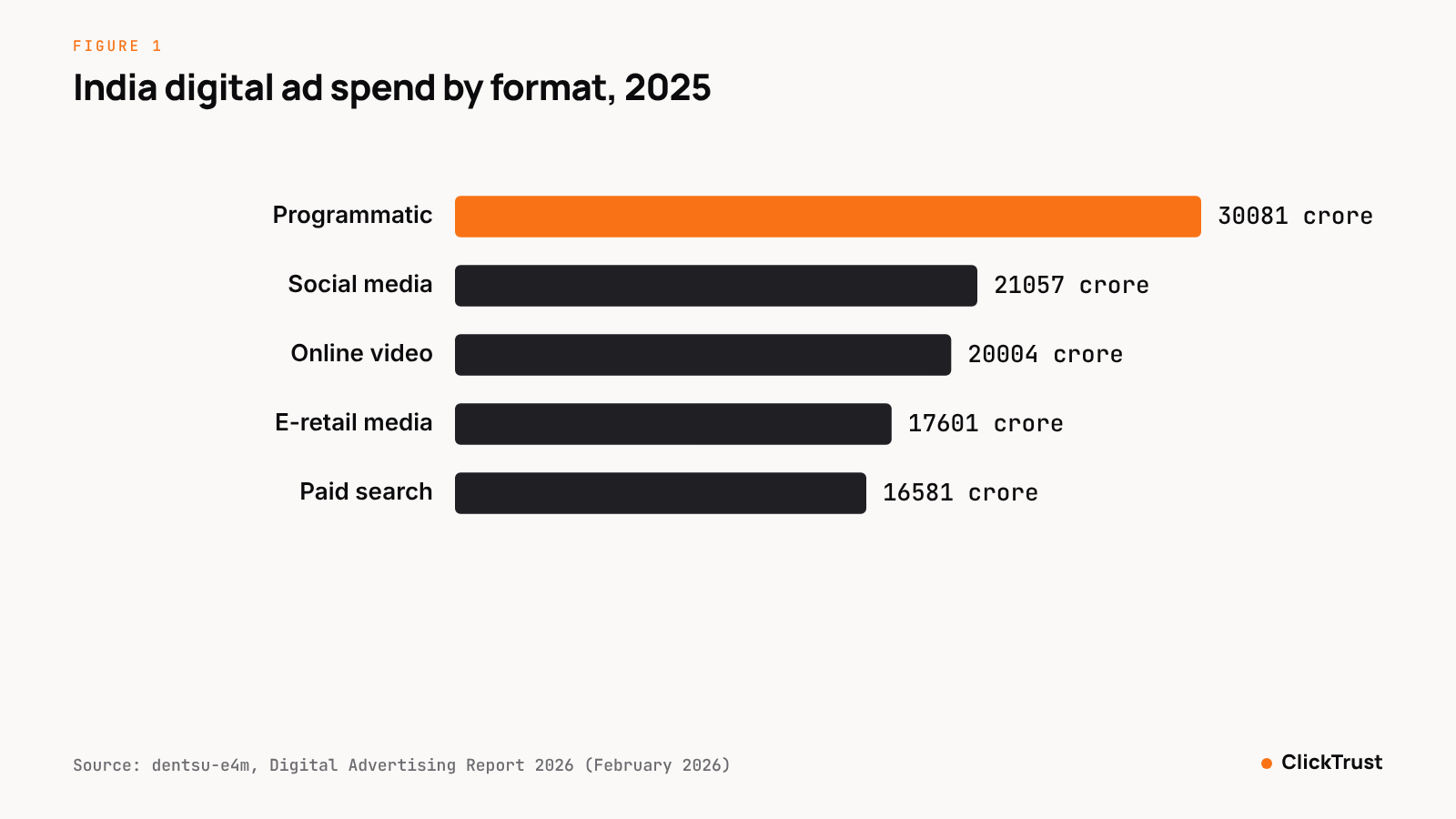 Figure 1. dentsu-e4m's Digital Advertising Report 2026 puts programmatic at Rs 30,081 crore, 42% of India's digital ad spend in 2025.
WPP Media's This Year Next Year forecast, as reported by Social Samosa, put total Indian ad revenue at Rs 2,01,891 crore for 2026 with digital at 68.1% and commerce-led advertising growing fastest at 24.2% (Social Samosa). Its mid-year revision trimmed growth to 8.8% but kept commerce media rising 29% (WPP Media). Programmatic, retail media and long-tail SME spend are where invalid traffic concentrates, because they are bought at scale with the least scrutiny.
Where does invalid traffic enter India's market?
Three doors carry most of it, and each has a different kind of evidence behind it.
Programmatic and retail media. Programmatic is 42% of India's digital spend, and the ANA's benchmark of large advertisers found $26.8 billion of global media value still lost each year to programmatic inefficiencies (ANA). In Q4 2025, advertisers enforcing quality governance converted 56.7% of programmatic spend into benchmark-qualified impressions against 37.5% for lower performers (ANA). TAG's 2025 European Ad Fraud Savings Report measured invalid traffic at 10.36% in unfiltered video and display channels against about 1% in TAG Certified Channels (TAG). Indian programmatic buys without that certification face the unfiltered rate. See programmatic protection.
In-app and affiliate. AppsFlyer's State of Fraud for Marketers 2026 reports that India accounts for nearly 28% of all global Android install fraud and that the affiliate share of India's fraud grew 14% year on year, from 57% to 65% (AppsFlyer). Fake installs made up 87% of detected Android fraud and 92% of iOS fraud, and physical device farms grew 72% year on year while emulator fraud fell 32% (AppsFlyer). Our affiliate fraud detection guide explains how to score partners out.
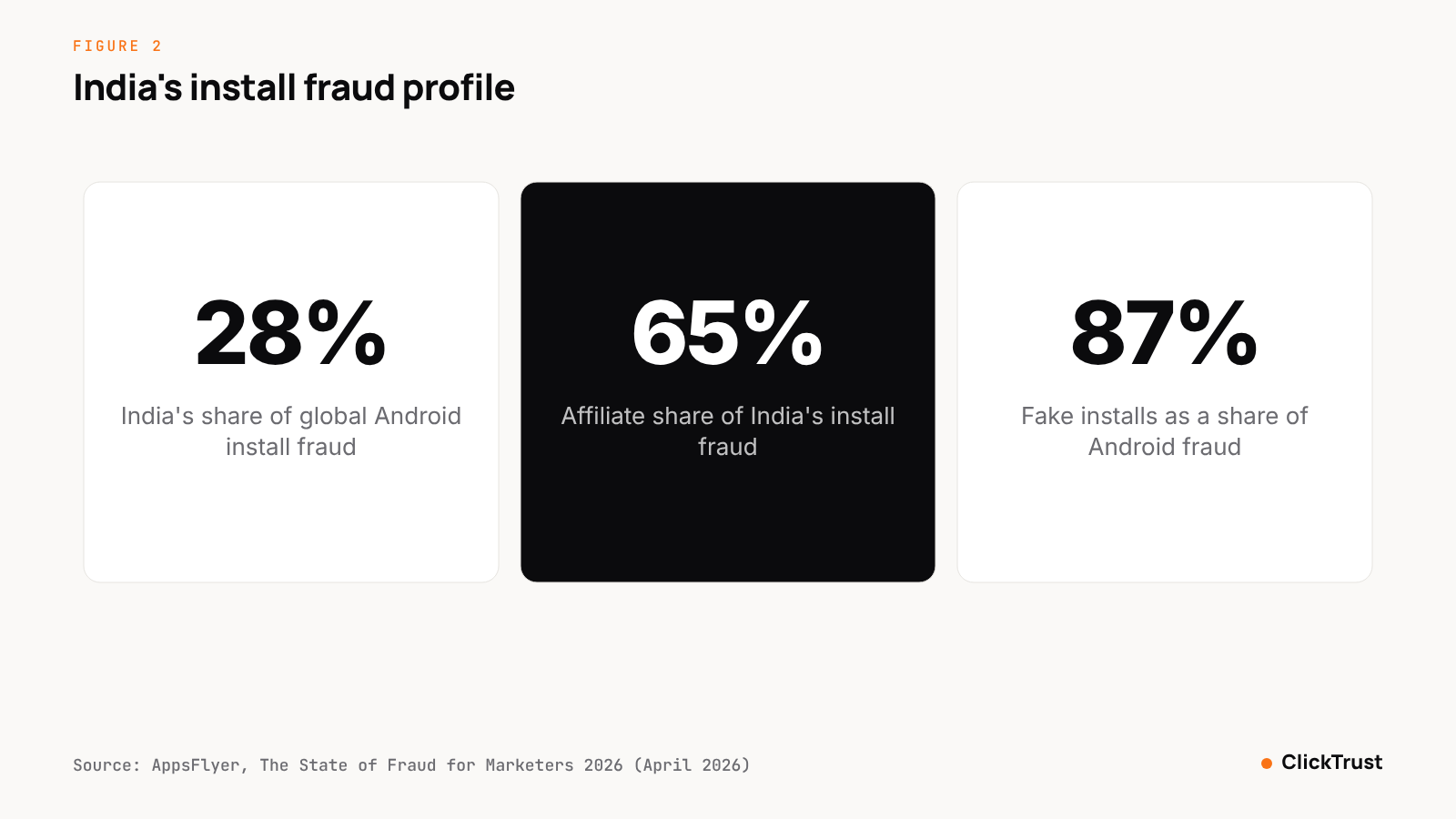 Figure 2. AppsFlyer's State of Fraud for Marketers 2026: India is nearly 28% of global Android install fraud, affiliates supply 65% of it, and fake installs are 87% of Android fraud.
Bots on the landing page. Imperva's 2025 Bad Bot Report ranked India among the top five most-targeted countries in APAC, with 9% of all bot attacks in the region in 2024 (Imperva). Its 2026 report found bots generated more than 53% of all web traffic in 2025, with 40% of bot traffic malicious (Imperva). Akamai reported bot activity against commerce sites growing 63% in APAC in 2025, the fastest of any region (Akamai). Every one of those bots that arrives through a paid link is a click an Indian advertiser paid for.
What do India's cyber-fraud figures show?
The infrastructure behind click fraud, meaning fake accounts, device farms, SIM farms and scam ads, is the same infrastructure behind consumer fraud, and India measures the consumer side closely. According to the Ministry of Home Affairs, financial-fraud complaints on the National Cyber Crime Reporting Portal rose from 6,94,446 in 2022 to 13,10,357 in 2023, 19,18,835 in 2024 and 24,02,579 in 2025, with reported losses of Rs 2,290 crore, Rs 7,465 crore, Rs 22,848 crore and Rs 22,495 crore in those years (Ministry of Home Affairs / I4C). The same reply says more than Rs 8,189 crore was saved across 23.61 lakh complaints through the Citizen Financial Cyber Fraud Reporting and Management System as of December 31, 2025.
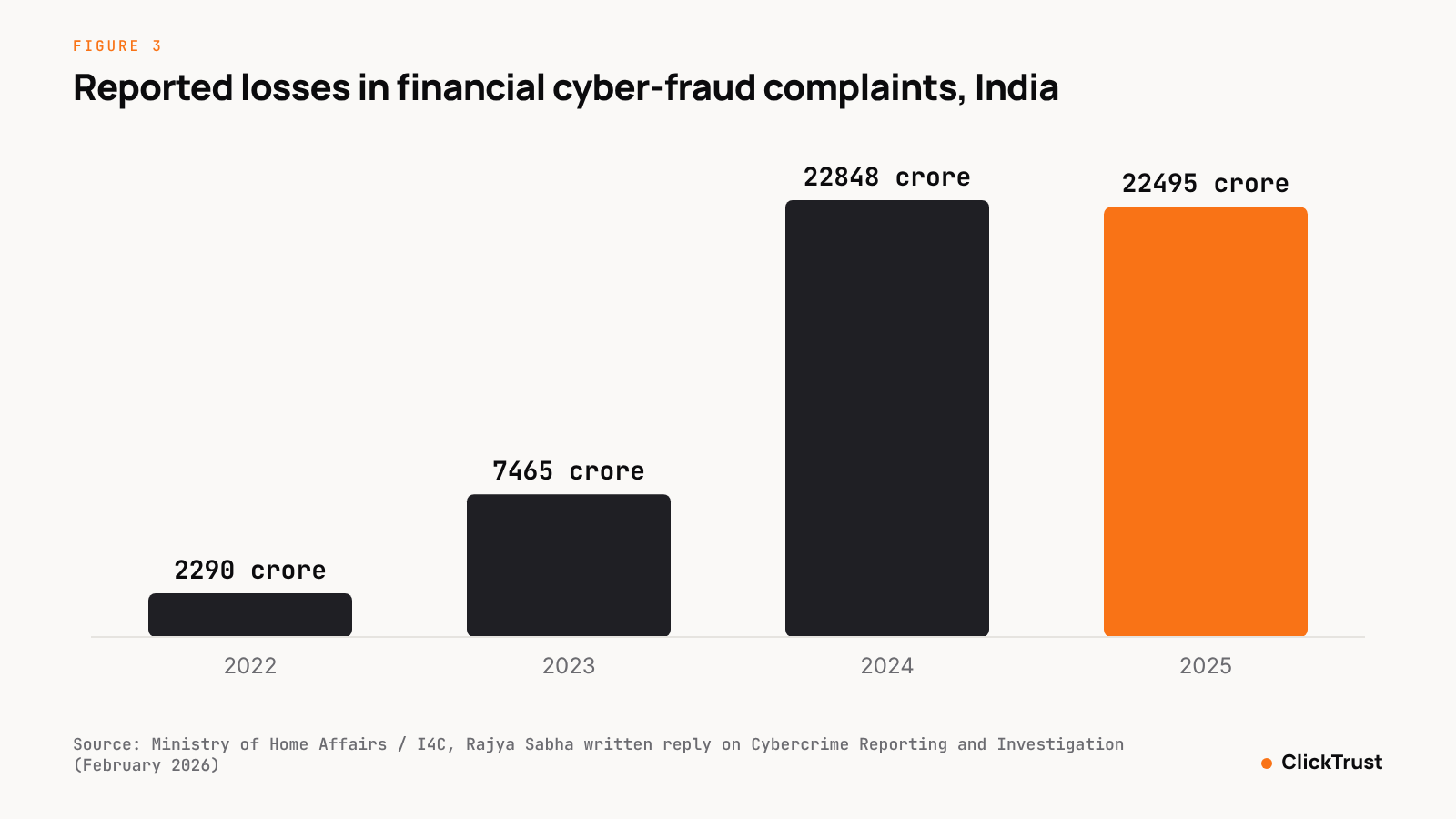 Figure 3. Reported losses in financial cyber-fraud complaints rose from Rs 2,290 crore in 2022 to Rs 22,495 crore in 2025, according to the Ministry of Home Affairs.
A complaint count that more than tripled in three years tells advertisers two things. The operators running those schemes recruit victims through paid ads, so Indian ad platforms carry a heavy enforcement load. And the same operators sell the clicks, installs and leads that land in legitimate advertisers' reports, because a device farm built for one job is rented for the other.
What is Google doing about it in India?
Google's India edition of its 2025 Ads Safety Report says it blocked or removed 483.7 million ads in India and suspended 1.7 million advertiser accounts in 2025 (Google India). Globally, the single largest enforcement category was Abusing the Ad Network, at more than 1.29 billion ads, ahead of personalization violations, legal requirements, misrepresentation and trademark (Google).
Those figures cover advertiser-side abuse, not the invalid clicks arriving on legitimate advertisers' campaigns. On that side, Google says you are not charged for invalid traffic detected before billing, credits post-billing detections as a billing adjustment, and now shows both amounts as "Estimated savings" and "Credited cost" in an Invalid traffic card (Google Ads Help). Google also says its protections cut advertiser exposure to invalid leads by an average of 30% so far in 2026 (Google). The gap is in what the filters miss, which is why independent measurement after the platform's filter still matters.
Which sectors in India are most exposed?
| Sector | Checkable evidence | Why India is exposed |
|---|---|---|
| Gambling and real-money gaming | Android install fraud 59%, peak 64% in Q4 2025 (AppsFlyer) | Sign-up bonuses and first-deposit payouts reward fake accounts |
| Fintech and lending | Android install fraud 31%; finance is 33% of Android install hijacking (AppsFlyer); 24% of bot attacks and 46% of account takeovers (Imperva) | Paid KYC on every fake install; account takeover targets wallets |
| E-commerce and retail media | E-retail media up 55.86% (dentsu-e4m); shopping affiliate fraud rose from 27% to 36% (AppsFlyer) | Bought programmatically at scale, paid on orders and installs |
| Edtech | No allowed-source rate available | Lead forms and competitor bidding attract automation |
| Real estate | No allowed-source rate available | High-value leads bought through portals and partners |
Sources: AppsFlyer, The State of Fraud for Marketers 2026; Imperva, Bad Bot Report 2026; dentsu-e4m via Social Samosa.
Gambling and real-money gaming. AppsFlyer measured Android install fraud for gambling apps at 59% in Q1 2026, up from 49%, with a peak of 64% in Q4 2025 and a Real Users Lift of 175%, meaning fake installs far outnumbered real ones (AppsFlyer). Sign-up rewards make every fake account worth money to its creator. See iGaming protection.
Fintech and lending. AppsFlyer reports a 31% install-fraud rate for finance apps on Android, with Real Users Lift stuck at 50 to 53% for five straight quarters, and finance accounting for 33% of Android install hijacking (AppsFlyer). Imperva found financial services absorbed 24% of all bot attacks and 46% of account-takeover incidents in 2025 (Imperva). Sumsub reports synthetic-personal-data fraud attacks in APAC rose 142% year on year to 15.7% of all attempts (Sumsub). A fake lending install also triggers paid KYC checks, so it costs more than its media. See fintech protection.
E-commerce and retail media. Shopping apps run a lower Android install-fraud rate of 10%, but AppsFlyer found shopping affiliate fraud rose 31% from 27% to 36%, peaking at 41% in Q4 2025 (AppsFlyer). Akamai found commerce absorbed 47.9% of all AI bot traffic on its network in the second half of 2025 (Akamai). With e-retail media India's fastest-growing line, this is where programmatic waste scales fastest. See e-commerce protection.
Edtech and real estate. No allowed publisher gives an India rate for either, so treat the exposure as structural rather than quantified. Both buy leads, both bid on competitor names, and both pay per form fill, which bots and paid form-fillers produce at scale. Counselor contact rate and site-visit rate are the metrics to watch. See edtech protection.
What does protection change?
The industry bodies that measure certified versus uncertified supply give the clearest answer. TAG reported invalid traffic under 1% in TAG Certified Channels in the United States for the fourth consecutive year, across 745 billion impressions, and credited industry anti-fraud programs with saving advertisers $10.8 billion in 2023 (TAG). In Europe, the same standards saved an estimated 3.45 billion euros while the 24% of spend in unprotected channels sustained more than ten times the relative losses (TAG).
Protection also improves the performance numbers, not just the waste numbers. ANA's case studies show nearly 40% reductions in cost per conversion when buyers optimize to quality-adjusted metrics (ANA). For an Indian advertiser, the practical reading is that the budget does not need to grow; it needs to stop paying for the invalid share.
What should Indian advertisers do?
- Measure after the platform's filter, not before. Platform refunds cover only what the platform detects. Monitor landing pages and in-app events independently to see what gets through, then claim refunds with evidence through Google's Click Quality Form within its 60-day window.
- Audit affiliate and partner traffic first. With AppsFlyer putting the affiliate share of India's install fraud at 65%, this is the highest-yield audit. Track every partner on its own link, score postbacks server-side and hold payouts on flagged installs. See affiliate traffic protection.
- Buy programmatic and retail media through certified paths. TAG's gap between about 1% and 10.36% is the difference between a certified chain and an unfiltered one. Ask every DSP, SSP and retail-media network what it is certified against and what it filters pre-bid.
- Tie spend to downstream outcomes. For lending, use KYC completion and disbursal; for gaming, first deposit; for edtech, counselor contact rate; for e-commerce, paid orders net of refunds. Optimize bidding to those events rather than to clicks or form fills. Our post on why a low CAC can be a warning sign gives a five-step check.
- Read the full dataset. The State of Invalid Traffic 2026 report compiles the regional and sector benchmarks, including India, in one place.
How ClickTrust helps
ClickTrust is built by ClearTrust, an Indian company, for exactly this market. Its 320 detection traps, each labeled GIVT or SIVT in line with MRC invalid-traffic guidance, score every event in under 50 milliseconds with a single Traffic Quality Index. Web Protection pushes IP and audience exclusions to Google Ads, Meta and Bing automatically; In-App Protection, with native iOS, Android and Flutter SDKs, catches emulators, click injection, repackaged apps and install hijacking; and Lite-MMP Attribution scores every affiliate postback. Typical ClickTrust audits find 14 to 42 percent of paid traffic is invalid depending on channel, and ClickTrust is free to start.
Sources
- Social Samosa (reporting the dentsu-e4m Digital Advertising Report 2026), Digital becomes India's largest ad channel: dentsu report (February 2026), https://www.socialsamosa.com/report/digital-becomes-indias-largest-ad-channel-dentsu-report-11067359
- EY India, India's media and entertainment sector grew 9% to INR2.78 trillion in 2025, driven by digital and live experiences: FICCI-EY report (March 2026), https://www.ey.com/en_in/newsroom/2026/03/india-s-media-and-entertainment-sector-grew-9-percent-to-inr-2-point-78-trillion-in-2025-driven-by-digital-and-live-experiences-ficci-ey-report
- Social Samosa (reporting WPP Media's This Year Next Year India), India ad revenue to reach ₹2 lakh crore in 2026: WPP Media TYNY report (February 2026), https://www.socialsamosa.com/report/india-ad-revenue-reach-two-lakh-crore-in-2026-wpp-media-tyny-report-11125350
- WPP Media, This Year Next Year: India Midyear 2026 (June 2026), https://www.wppmedia.com/news/this-year-next-year-india-midyear-2026
- AppsFlyer, The State of Fraud for Marketers – 2026 Edition (April 2026), https://www.appsflyer.com/resources/reports/state-fraud-marketers-report/
- ANA, The ANA Q2 2025 Programmatic Transparency Benchmark Finds $26.8B in Wasted Programmatic Spend (August 2025), https://www.ana.net/content/show/id/pr-2025-08-programmatictrans
- ANA, ANA Q4 2025 Programmatic Transparency Benchmark Shows Media Quality Is Now Driving Measurable Performance Outcomes (February 2026), https://www.ana.net/content/show/id/pr-2026-02-programatic
- TAG, 2025 European Ad Fraud Savings Report (2025), https://ppc.land/content/files/2025/06/2025_TAG_EuropeanFraudSavingsReport-Final-compressed.pdf
- TAG, US Ad Industry Extends Success in Fight Against Fraud with Fourth Straight Year of Sub-1% IVT in TAG Certified Channels (October 2024), https://www.tagtoday.net/pressreleases/us-ad-industry-extends-success-in-fight-against-fraud-with-fourth-straight-year-of-sub-1-ivt-in-tag-certified-channels
- Imperva (a Thales company), 2025 Imperva Bad Bot Report, India press release via CXO Today (April 2025), https://cxotoday.com/press-release/artificial-intelligence-fuels-rise-of-hard-to-detect-bots-that-now-make-up-more-than-half-of-global-internet-traffic-according-to-the-2025-imperva-bad-bot-report/
- Imperva, Bad Bot Report 2026: The Internet Is No Longer Human and It's Changing How Business Works (April 2026), https://www.imperva.com/blog/bad-bot-report-2026-bots-agentic-age/
- Akamai, Akamai Research: Commerce Becomes the Epicenter for AI Bot Attacks and Agentic Fraud in 2026 (July 2026), https://www.akamai.com/newsroom/press-release/akamai-research-commerce-becomes-the-epicenter-for-ai-bot-attacks-and-agentic-fraud-in-2026
- Ministry of Home Affairs / I4C, Cybercrime Reporting and Investigation, written reply in the Rajya Sabha (PIB release, February 2026), https://pubt.io/view/139F97FD8388AA51A1E4DCC3FB8C58BF207BFAC5
- Google India, Gemini is stopping harmful ads before people ever see them (India edition of the 2025 Ads Safety Report, April 2026), https://blog.google/intl/en-in/products/google-companies/gemini-is-stopping-harmful-ads-before-people-ever-see-them/
- Google, 2025 Ads Safety Report (April 2026), https://services.google.com/fh/files/blogs/global_2025_adssafetyreport.pdf
- Google, About invalid traffic – Google Ads Help (fetched November 2026), https://support.google.com/google-ads/answer/11182074?hl=en
- Google, We're introducing a new transparency tool for invalid traffic in Google Ads (November 12, 2026), https://blog.google/products/ads-commerce/invalid-traffic-overview-google-ads/
- Sumsub, Annual Sumsub Report Reveals Synthetic Personal Data in APAC Soars 142% YoY Amidst Fraud Crackdowns (November 2025), https://www.aap.com.au/aapreleases/cision20251125ae32757
- Media Rating Council, Media Rating Council (MRC) Issues Final Version Of Invalid Traffic Detection And Filtration Guidelines Addendum (October 2015), https://prnewswire.com/news-releases/media-rating-council-mrc-issues-final-version-of-invalid-traffic-detection-and-filtration-guidelines-addendum-300166843.html
Frequently asked questions
What is the click fraud rate in India?
No single India-wide click fraud rate exists from a publisher that measures all channels. The checkable figures are channel-specific: AppsFlyer puts India at nearly 28% of global Android install fraud with affiliates supplying 65% of it, Imperva found India accounted for 9% of all bot attacks in APAC, and TAG's benchmark shows unfiltered channels running at 10.36% invalid traffic against about 1% in certified channels.
How big is India's digital ad market in 2026?
dentsu-e4m's Digital Advertising Report 2026 puts digital at Rs 71,621 crore in 2025, 59% of a Rs 1,21,339 crore market, and projects Rs 98,034 crore and a 70% share by 2027. FICCI-EY reports INR 947 billion, or 63% of ad revenue. WPP Media's This Year Next Year forecast total Indian ad revenue of Rs 2,01,891 crore in 2026 with digital at 68.1%.
Which industries in India face the most click fraud?
On mobile, AppsFlyer reports Android install fraud of 59% for gambling apps and 31% for finance apps, against 10% for shopping and 7% for gaming. Imperva found financial services absorbed 24% of all bot attacks and 46% of account-takeover incidents in 2025. Real-money gaming, lending, edtech lead generation and e-commerce retail media are the Indian categories most exposed.
How much of India's ad fraud comes from affiliates?
A large and growing share. AppsFlyer's State of Fraud for Marketers 2026 reports that the affiliate share of India's install fraud rose 14% year on year, from 57% to 65%, and that fake installs make up 87% of detected Android fraud. Auditing partner traffic on its own tracking links, with server-side postback scoring, is the highest-yield first step for Indian advertisers.
Does Google refund click fraud in India?
Google's policy is global. It says you are not charged for invalid traffic detected before billing, credits post-billing detections as a billing adjustment, and reviews requests covering the last 60 days through its Click Quality Form. In India it blocked or removed 483.7 million ads in 2025. Independent monitoring is still needed to catch and claim what the platform's own filters miss.
How much are Indians losing to online fraud?
According to the Ministry of Home Affairs, financial-fraud complaints on the National Cyber Crime Reporting Portal reached 24,02,579 in 2025 with reported losses of Rs 22,495 crore, up from 6,94,446 complaints and Rs 2,290 crore in 2022. The same fake accounts, device farms and scam ads that drive consumer fraud also generate the invalid traffic that advertisers pay for.