Affiliate Fraud Detection Guide 2026: Types, Signals, Vetting
ClickTrust Research · · 11 min read · affiliate fraud · install fraud · attribution · postbacks · invalid traffic
TL;DR Affiliate fraud detection means scoring every partner-sourced click, install, lead and sale before the partner is paid, because the affiliate channel pays on outcomes and outcomes are what a motivated partner can fake. AppsFlyer found affiliates running an install fraud rate of about 40% against about 1% for self-reporting networks, a 36x gap, so server-to-server postback scoring with hold and clawback terms is the practical defense.

Key takeaways
- AppsFlyer's dataset of more than 100 billion installs found affiliates supplying about 40% of fraudulent installs at a fraud rate of roughly 40% every quarter, against about 1% for self-reporting networks, a 36x gap.
- Fraud is spreading beyond the affiliate channel: AppsFlyer measured owned-media install fraud rising 221% from 3.4% to 11% and DSP fraud rising 59% from 5.6% to 8.9% in a year.
- The affiliate share of install fraud rose from 57% to 65% in India, from 42% to 57% in the UK and from 32% to 55% in Pakistan, according to AppsFlyer.
- Fake installs made up 87% of detected Android fraud and 92% of iOS fraud, and physical device farms grew 72% while emulator fraud fell 32%, so partner installs increasingly come from real handsets.
- Seven techniques cover most partner fraud: cookie stuffing, click spamming, click injection, install hijacking, fake leads, incentivized traffic and postback manipulation, each with a distinct fingerprint in your reports.
- Postback-level scoring works by receiving conversions server-to-server, scoring each event, rolling scores up into a per-partner fraud score, and holding or clawing back payouts on flagged conversions.
What is affiliate fraud detection?
Affiliate fraud detection is the process of identifying partner-sourced clicks, installs, leads and sales that were manufactured or misattributed rather than earned, before the partner is paid for them. It matters because the affiliate channel pays on outcomes, and outcomes are exactly what a motivated partner can fake. AppsFlyer's State of Fraud for Marketers 2026 found affiliates supplying about 40% of fraudulent installs at a fraud rate of roughly 40% every quarter, against about 1% for self-reporting networks, a 36x gap (AppsFlyer).
Affiliate fraud is any technique by which a partner claims credit, and payment, for a click, install, lead or sale that it did not genuinely generate, including cookie stuffing, click spamming, click injection, install hijacking, fake leads, incentivized traffic and postback manipulation. The Media Rating Council defines sophisticated invalid traffic as traffic identified through advanced analytics, multipoint corroboration and human intervention, with hijacked devices, ad tags or creative, adware, malware and misappropriated content as its examples (MRC). Its 2020 update added more specific SIVT areas and formal machine-learning and human-intervention requirements (MRC). Most affiliate fraud falls on the sophisticated side of that line.
How much affiliate traffic is fraudulent?
The best measured answer comes from mobile, where an attribution platform sees every install and its source. AppsFlyer's dataset covers more than 100 billion installs across 246,000 apps from Q1 2025 to Q1 2026 (AppsFlyer).
| Finding (AppsFlyer, The State of Fraud for Marketers 2026) | Figure |
|---|---|
| Affiliate share of fraudulent installs | About 40%, at a fraud rate of roughly 40% every quarter |
| Self-reporting network share of fraudulent installs | 1.5%, at a fraud rate of about 1% |
| Fraud gap between affiliates and self-reporting networks | 36x in Q1 2026 |
| Organic share of all fraudulent installs | 52%, the single largest fraud channel |
| Owned-media install fraud rate | Up 221%, from 3.4% to 11% |
| DSP install fraud rate | Up 59%, from 5.6% to 8.9% |
| Shopping affiliate fraud rate | Up from 27% to 36%, peaking at 41% in Q4 2025 |
| Social media affiliate fraud rate | Near 50% |
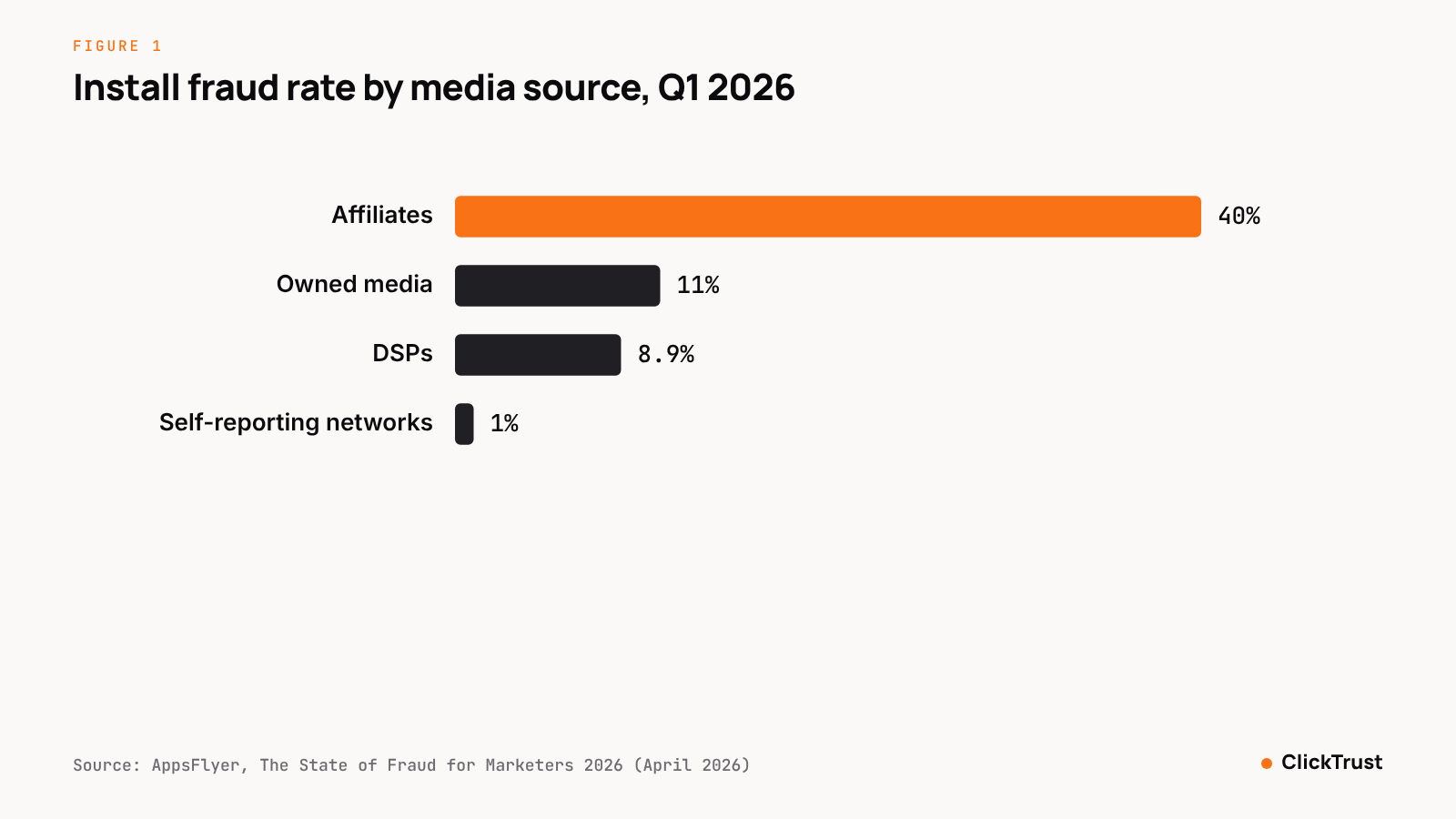 Figure 1. AppsFlyer's State of Fraud for Marketers 2026 puts the affiliate install fraud rate at about 40%, against 11% for owned media, 8.9% for DSPs and about 1% for self-reporting networks.
Two things stand out. The affiliate rate has held at roughly 40% every quarter, and fraud is spreading into channels once considered clean, with owned-media fraud more than tripling and DSP fraud up 59% (AppsFlyer). An expert note in the same report, from InMobi, observes that about 5% of supply paths account for over 65% of detected fraudulent installs, so the problem is concentrated and findable (AppsFlyer).
The affiliate share is rising fastest in large, price-sensitive markets. AppsFlyer reports the affiliate share of install fraud grew from 57% to 65% in India, from 42% to 57% in the UK and from 32% to 55% in Pakistan (AppsFlyer). Our post on click fraud in India sets the Indian figure in its market context.
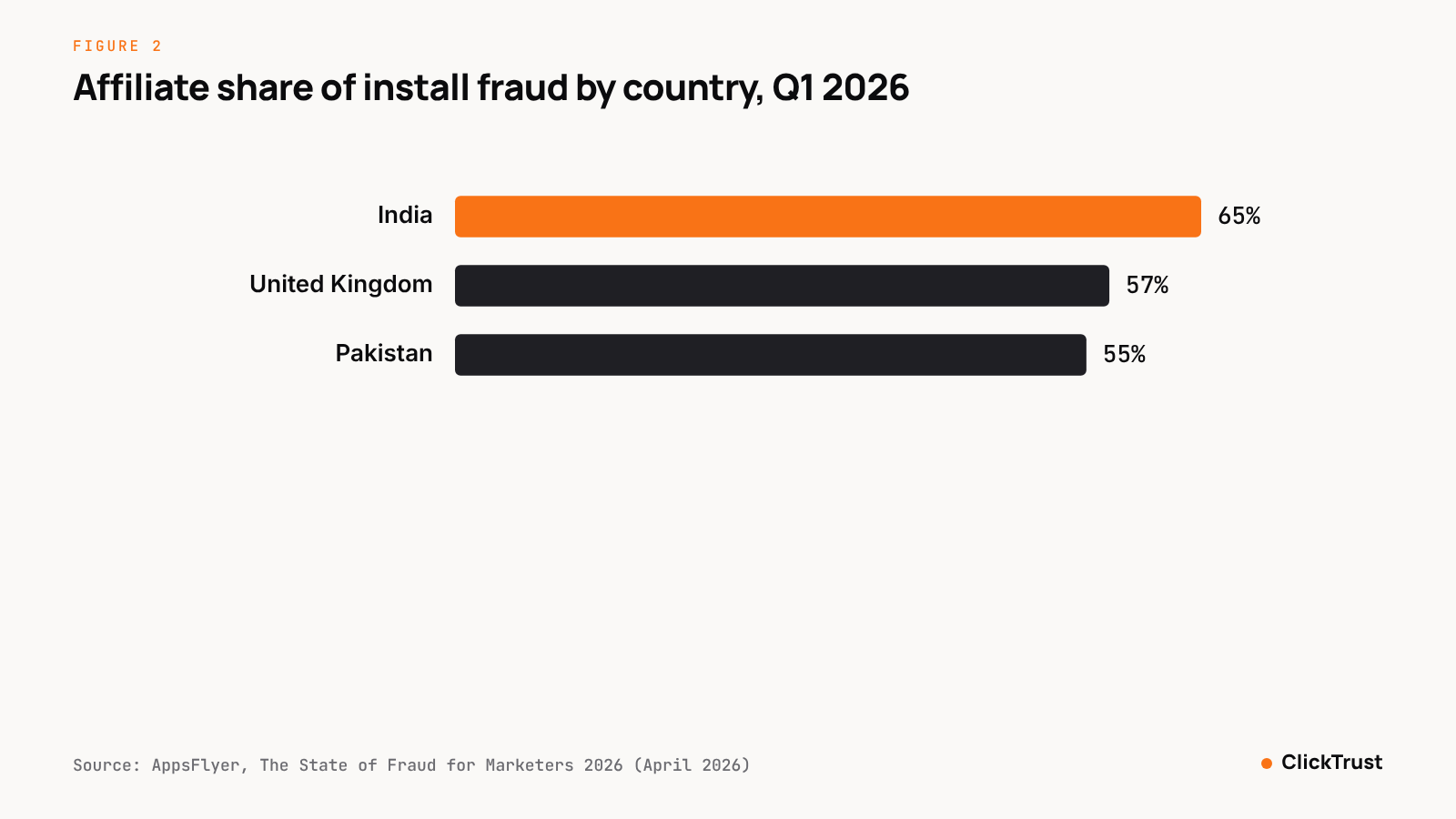 Figure 2. AppsFlyer's State of Fraud for Marketers 2026 puts the affiliate share of install fraud at 65% in India, 57% in the UK and 55% in Pakistan.
Sector matters. AppsFlyer measured Android install fraud for gambling apps at 59% in Q1 2026, with a peak of 64% in Q4 2025 and a Real Users Lift of 175%, and found finance accounting for 33% of all Android install hijacking (AppsFlyer). Sign-up bonuses and first-deposit payouts give a partner a second reason to fake the user. See iGaming protection.
Why is web affiliate fraud harder to measure than app fraud?
No comparable published fraud rate exists for web affiliate traffic, and the reason is structural. On mobile, an attribution platform sits between the partner and the install and sees the device, the click and the open. On the web, attribution usually runs on cookies and pixels the partner can influence, and the conversion is often reported by a tag the partner helped place.
The closest the industry has to a standard is TAG's Certified Channel: a transaction in which the agency, buying platform and selling platform are all Certified Against Fraud (TAG). Most affiliate chains have no equivalent, because a network, a sub-network and an undisclosed sub-affiliate sit between advertiser and traffic. That is why measurement has to move to the one place the partner cannot touch: the advertiser's own server.
How does affiliate and partner fraud work?
Each technique attacks a different point in the attribution chain: the click, the device, the conversion or the postback.
Cookie stuffing
The partner drops its tracking cookie on a user's browser without the user clicking anything, through a hidden iframe, image pixel or redirect on an unrelated page. If that user later buys from you through any route, last-click attribution pays the partner. Thin referred traffic with rich conversions is the fingerprint.
Click spamming
Also called click flooding. The partner fires large volumes of fake clicks for users who never saw an ad, often from a background app or a malicious SDK. The aim is to be the last click before an organic install or purchase. This is one reason AppsFlyer finds organic accounting for 52% of all fraudulent installs: a stolen organic install is counted where it was claimed (AppsFlyer).
Click injection
An Android-specific variant. A malicious app on the device listens for the install broadcast, fires a click in the seconds between download and first open, and wins last-touch attribution for an install that was already happening. The fingerprint is a click-to-install time measured in seconds rather than minutes or hours.
Install hijacking
The broader family of techniques that steal attribution for real installs: click injection, device-ID spoofing, repackaged apps and device farms that replay install events. The partner reports an install that occurred, but it did not cause it, which is why in-app detection has to look at the device, not just the click. AppsFlyer found physical device farms growing 72% year on year while emulator fraud fell 32%, so the devices increasingly pass basic integrity checks (AppsFlyer).
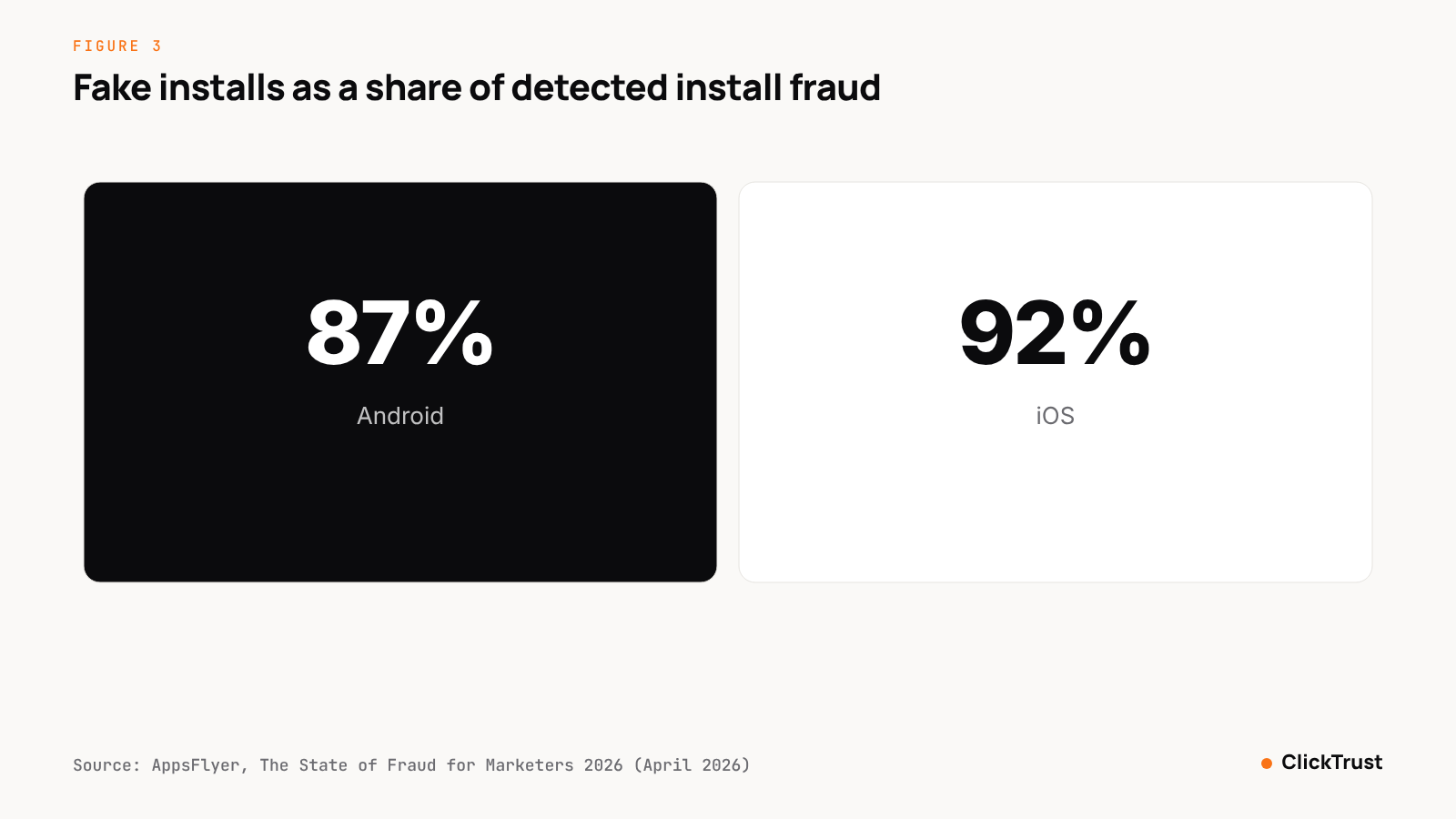 Figure 3. AppsFlyer's State of Fraud for Marketers 2026 found fake installs made up 87% of detected Android fraud and 92% of iOS fraud.
Most partner fraud, though, is not hijacking at all. Fake installs, meaning installs with no real user behind them, made up 87% of detected Android fraud and 92% of iOS fraud (AppsFlyer). The partner is not stealing your users. It is manufacturing them.
Fake leads
Bots or low-paid workers submit your forms with real-looking names, numbers and emails. Lead generation is structurally exposed because a form submission is far easier to fake than a payment. Google's Click Quality Form explicitly accepts investigation requests for "poor-quality form submissions" alongside invalid clicks (Google Ads Help), and Google says its protections cut advertiser exposure to invalid leads by an average of 30% so far in 2026 (Google). Our guide to fake leads and lead-form spam covers the form-level defenses.
Incentivized traffic
The partner pays users, through offerwalls, reward apps or cash-back schemes, to install or sign up. The users are real but have no interest in the product, so they open once and leave. Disclosed incent traffic is a legitimate discount product; it becomes fraud when passed off as non-incentivized.
Postback manipulation
The partner tampers with the conversion signal itself: replaying postbacks, duplicating transaction IDs, firing conversion pixels from its own servers, or spoofing the tracking platform's callback. This is the endpoint of the usual escalation, from inflating clicks to inventing conversions.
Fraud type, symptom and detection signal
| Fraud type | What you see in your reports | Detection signal |
|---|---|---|
| Cookie stuffing | High conversions from a partner with little or no referred traffic; conversions on users who never visited a partner page | Click-to-conversion gaps of days; cookies set from pages unrelated to your product; many clicks per user with no page view |
| Click spamming | Huge click volumes with near-zero conversion rates; organic conversions suddenly attributed to one partner | Flat click distribution around the clock; click timestamps unrelated to any user action; clicks from devices that never saw an impression |
| Click injection | Installs whose last click came seconds before first open; one partner wins attribution it never earned | Click-to-install time clustered under a few seconds; clicks fired after the download began; install-broadcast timing on Android |
| Install hijacking | Unusually high share of attribution wins against other partners; repeated last-touch overrides | Attribution overrides concentrated on one partner; device signals showing emulators, repackaged apps, device farms or spoofed device IDs |
| Fake leads | Good cost per lead, poor contact rate; duplicate phone numbers and emails | Form-fill times under a second; repeated device fingerprints; disposable email domains; leads that never answer |
| Incentivized traffic | Installs that open once; sign-ups that never activate; volume spikes tied to reward apps | Session depth near zero; retention curves that collapse after day 1; referrers tied to offerwalls |
| Postback manipulation | Conversions in the partner's dashboard that do not match yours; duplicate or replayed conversions | Postbacks without a matching server event; duplicate transaction IDs; signature or token mismatches |
How does postback-level scoring work?
Postback-level scoring moves fraud detection from the click to the point of payment. Instead of paying on whatever the partner's link reported, you score each conversion before the partner's postback fires.
- Receive conversions server-to-server. Your backend, not the user's browser or the partner's pixel, reports each conversion to the tracking platform. Browser-side pixels can be fired by anyone who can load a URL; a server-to-server postback carries a transaction ID, a timestamp and a signature that only your system can produce.
- Match each conversion to its originating event. The tracker links the conversion to the click or install that claimed it, and records the gap between them, the device and network on both sides, and whether an impression preceded the click.
- Score the event. Each conversion gets a fraud score built from device integrity (emulator, rooted device, repackaged app, device-farm signatures), timing (click-to-install and click-to-conversion distributions), network (data-center IPs, proxies, known click-farm ranges) and behavior (session depth, activation, retention). ClickTrust calls this the Traffic Quality Index.
- Roll scores up per partner and sub-ID. A single bad conversion proves little. A sub-ID whose conversions score badly in aggregate, or whose score distribution diverges from your organic baseline, is a partner to act on. Because a few supply paths carry most of the fraud, this step is where most of the savings appear.
- Hold, then release or claw back. Conversions above the threshold are held rather than passed to the partner's postback. After a validation window, in which activation and retention data arrive, held conversions are either released and paid or rejected. Payouts already made on conversions later confirmed as fraud are clawed back under the contract.
The validation window is what makes the system work. Most of the techniques above are invisible at the moment of conversion and obvious a week later, when the install has not opened again, the lead has not answered and the order has been refunded.
Affiliate vetting checklist
Run this before onboarding any partner, and again at each quarterly review.
- Demand sub-ID transparency. Every placement, site, app or traffic source gets its own sub-ID, and the partner agrees that undisclosed sub-IDs are unpaid.
- Require written traffic-source disclosure. Search, social, display, email, incent, in-app and push each carry different risk. A partner that will not say where its traffic comes from has answered the question.
- Run a capped paid test. Set a volume cap and a validation window of at least the length of your activation cycle before any payout is released.
- Compare against your organic baseline. Click-to-conversion timing, device mix, geography, session depth and day-7 retention should resemble your organic users. A partner whose users look nothing like your organic cohort is sending you something other than customers.
- Insist on server-to-server postbacks. Reject partners who will only work from browser pixels or who ask for your conversion pixel to run on their own pages.
- Write hold and clawback terms into the contract. Specify the validation window, the fraud-score threshold, the evidence you will provide and the clawback period.
- Review per-partner fraud scores monthly. Cut or cap partners whose score trends upward, and share the evidence so honest partners can clean up their own sub-sources.
- Check the channel-level picture. Our affiliate traffic protection and in-app inventory pages set out what to expect from each source type.
How ClickTrust helps
ClickTrust's Lite-MMP Attribution layer gives every partner its own tracking links, receives conversions through server-to-server postbacks and scores each one in under 50 milliseconds with the Traffic Quality Index, rolling results up into a per-affiliate fraud score. In-App Protection, with native iOS, Android and Flutter SDKs, catches emulators, click injection, repackaged apps and install hijacking at the device. Its 320 detection traps are each labeled GIVT or SIVT in line with MRC invalid-traffic guidance, and every flagged conversion comes with a refund-ready evidence pack to put in front of a partner. Typical ClickTrust audits find 14 to 42 percent of paid traffic is invalid depending on channel, and ClickTrust is free to start.
Sources
- AppsFlyer, The State of Fraud for Marketers – 2026 Edition (April 2026), https://www.appsflyer.com/resources/reports/state-fraud-marketers-report/
- Media Rating Council, Media Rating Council (MRC) Issues Final Version Of Invalid Traffic Detection And Filtration Guidelines Addendum (October 2015), https://prnewswire.com/news-releases/media-rating-council-mrc-issues-final-version-of-invalid-traffic-detection-and-filtration-guidelines-addendum-300166843.html
- Media Rating Council, Media Rating Council Issues Update To Invalid Traffic Detection And Filtration Standards (June 2020), https://www.mediaratingcouncil.org/sites/default/files/News/General-Announcements/062520%20Media%20Rating%20Council%20Issues%20Update%20To%20Invalid%20Traffic%20Detection%20and%20Filtration%20Standards_Final.pdf
- TAG, 2025 European Ad Fraud Savings Report (2025), https://ppc.land/content/files/2025/06/2025_TAG_EuropeanFraudSavingsReport-Final-compressed.pdf
- Google, About the Invalid Activity Credit Report – Google Ads Help (2026), https://support.google.com/google-ads/answer/16826168?hl=en
- Google, We're introducing a new transparency tool for invalid traffic in Google Ads (November 12, 2026), https://blog.google/products/ads-commerce/invalid-traffic-overview-google-ads/
Frequently asked questions
What is affiliate fraud?
Affiliate fraud is any technique by which a partner claims credit, and payment, for a click, install, lead or sale it did not genuinely generate. Common forms are cookie stuffing, click spamming, click injection, install hijacking, fake leads, incentivized traffic and postback manipulation. The MRC's sophisticated invalid traffic category covers hijacked devices, ad tags and creative, adware, malware and misappropriated content.
How common is affiliate fraud?
On mobile, AppsFlyer's State of Fraud for Marketers 2026 found affiliates supplying about 40% of fraudulent installs at a fraud rate of roughly 40% every quarter, against about 1% for self-reporting networks, a 36x gap. Social media affiliate fraud ran near 50% and shopping affiliate fraud rose from 27% to 36%. No equivalent published rate exists for web affiliate traffic, which is one reason it goes unmeasured.
What is the difference between click spamming and click injection?
Click spamming fires large volumes of fake clicks for users who never saw an ad, hoping some later install organically and get attributed to the partner; the symptom is a near-zero click-to-install rate. Click injection fires a single click on an Android device in the seconds between download and first open, so it wins last-touch attribution; the symptom is click-to-install times clustered under a few seconds.
How does postback fraud scoring work?
Your server, not the user's browser, reports each conversion to the tracking platform. The platform matches it to the originating click or install, scores the event against device, timing, network and behavioral signals, and rolls scores up per partner and sub-ID. Conversions above a threshold are held rather than passed to the partner's postback, and payouts on confirmed fraud are clawed back within the contractual window.
How do I vet a new affiliate partner?
Ask for traffic-source disclosure by sub-ID, run a paid test with a cap and a validation window, compare its click-to-conversion timing and post-conversion behavior against your organic baseline, and write hold and clawback terms into the contract before the first payout. A partner that refuses sub-ID transparency or a validation window is telling you what to expect.