Fake Leads and Lead Form Spam: How to Spot and Stop Them (2026)
ClickTrust Research · · 10 min read · fake leads · lead form spam · lead generation · affiliate fraud · invalid traffic
TL;DR Fake leads are form submissions from bots, incentivized fillers, affiliate fraud rings or recycled contact data, and Google's Click Quality Form now accepts investigation requests for poor-quality form submissions alongside invalid clicks. The fix is a landing-page layer that validates every submission, scores every source and holds affiliate postbacks until a lead is verified.

Key takeaways
- Google's Click Quality Form explicitly covers poor-quality form submissions, clicks outside location targeting and sudden short-term cost increases, and reviews activity within the last 60 days, per Google Ads Help.
- Google said on November 12, 2026 that it had cut advertiser exposure to invalid leads by an average of 30% so far in 2026, but incentivized and affiliate leads arrive through channels Google never sees.
- Arkose Labs reported that 70.5% of registration sessions on traffic it protected were fake-account attempts in Q3 2026, a figure whose denominator the reporting article flags as unclear.
- Malicious login attempts averaged 10.6% of web traffic across more than 200 billion transactions, and more than one in five add-to-cart transactions were automated, per F5 Labs' 2025 Advanced Persistent Bots Report.
- Only 2.8% of about 17,000 popular domains were fully protected against test bots in 2025 and 61.2% let every test bot through, according to DataDome's Global Bot Security Report.
- Affiliates generated about 40% of fraudulent app installs with a roughly 40% fraud rate against about 1% for self-reporting networks, a 36x gap, per AppsFlyer's State of Fraud for Marketers 2026.
Fake leads are the lead-generation version of click fraud: form submissions that look like prospects but come from bots, incentivized form fillers, affiliate fraud rings or recycled contact data. They cost more than the click, because every one consumes sales time, pollutes the CRM and teaches your bidding algorithm to chase more of the same. This guide explains how fake leads get into your forms, what they cost, how to diagnose them, what Google will and will not review, and the seven controls that stop most of them.
Fake leads are form submissions, calls or sign-ups that do not come from a real person with real interest in your offer, whether they are generated by automation, paid for by incentive, fabricated by an affiliate or assembled from recycled personal data. Google's Ad Traffic Quality page applies the same test to invalid traffic, calling it "any interaction that doesn't come from real people with real interest in an ad" (Google, Google Ad Traffic Quality).
Why do lead-gen advertisers get more fake leads than e-commerce?
Lead-generation campaigns attract more fake conversions than transactional ones because the conversion is easier to fake. A purchase needs a card and a shipping address. A lead needs a name, an email and a phone number, and all three can be invented, bought or scraped.
The automation aimed at sign-up and login flows is measured at scale. F5 Labs' 2025 Advanced Persistent Bots Report (link), covering more than 200 billion web and API transactions, found malicious login attempts averaged 10.6% of web traffic and 5.2% of mobile-API transactions, more than half of all web content page requests came from scrapers, and more than one in five add-to-cart transactions were automated. If a fifth of add-to-cart actions can be scripted, a form that asks for nothing verifiable is trivial.
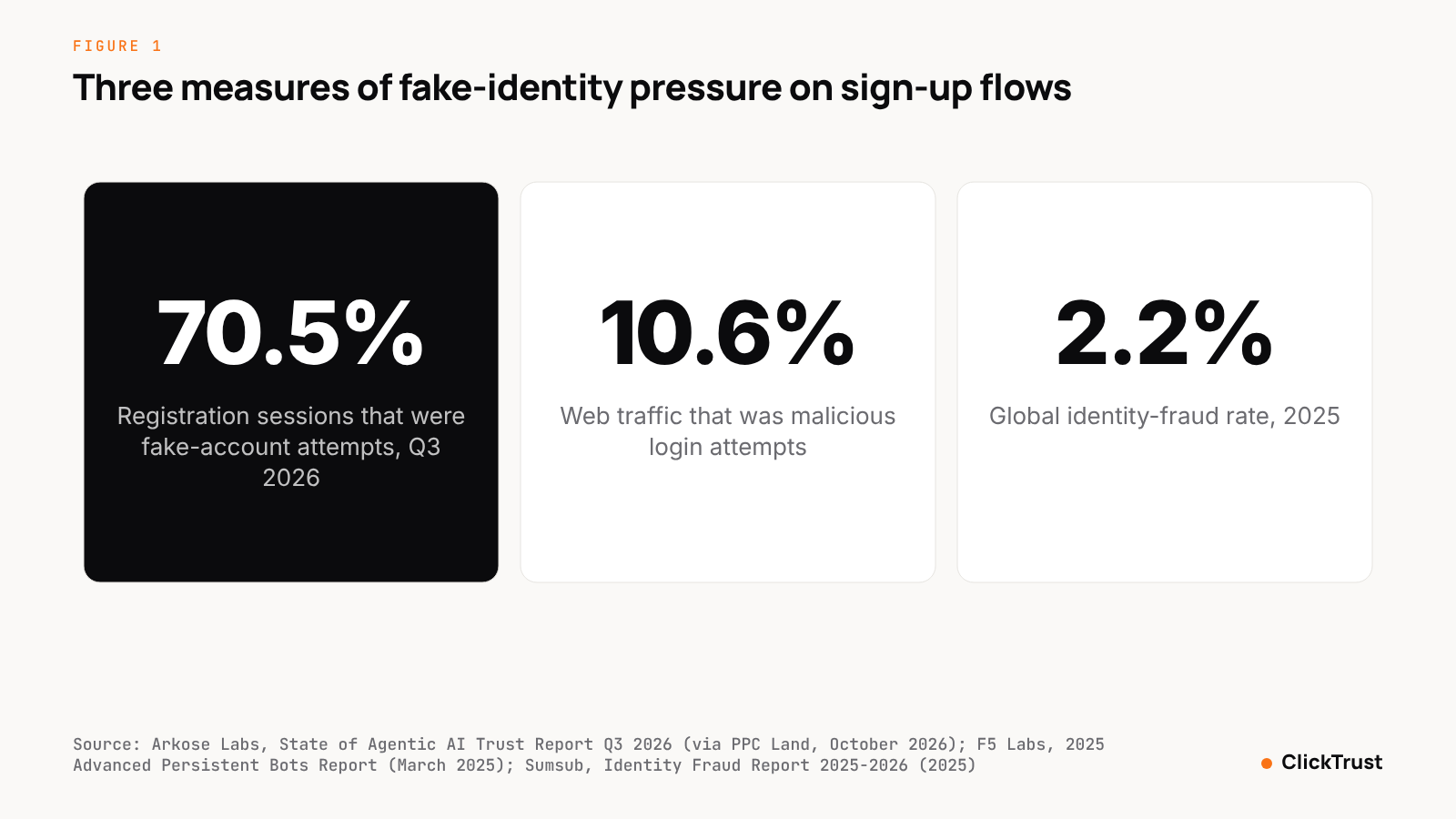 Figure 1. Three measures of fake-identity pressure, each on its own denominator, from Arkose Labs (registration sessions), F5 Labs (web traffic) and Sumsub (identity verifications).
Sumsub's Identity Fraud Report 2025-2026 (link) puts the global identity-fraud rate at 2.2% in 2025, with sophisticated attacks up 180% year on year. The sectors that live on lead forms carry extra exposure: Imperva's Bad Bot Report 2026 (link) found financial services absorbed 24% of all bot attacks and 46% of account-takeover incidents in 2025. If you run campaigns for fintech, real estate or edtech, your forms sit in the most-targeted part of the web.
How bots and fraud rings fill lead forms
Four mechanisms produce most fake leads. They often appear together in the same account, which is why a single fix rarely holds.
1. Automated form submission
Scripts and headless browsers load the landing page, fill every field with plausible values and submit. Simple versions post straight to the form endpoint without rendering the page. Sophisticated versions run a real browser, move the pointer, pause between fields and rotate residential IPs.
The scale shows up wherever registration is measured. Arkose Labs' State of Agentic AI Trust Report for Q3 2026, as reported by PPC Land (link), states that 70.5% of registration sessions on traffic Arkose protected were fake-account attempts; the article notes the denominator is ambiguous, so read it as pressure on heavily attacked sign-up flows rather than a universal rate.
Most sites are not stopping it. DataDome's Global Bot Security Report 2025 (link) tested about 17,000 popular domains across 22 industries and found only 2.8% fully protected against its test bots, 36% partially protected and 61.2% letting every test bot through.
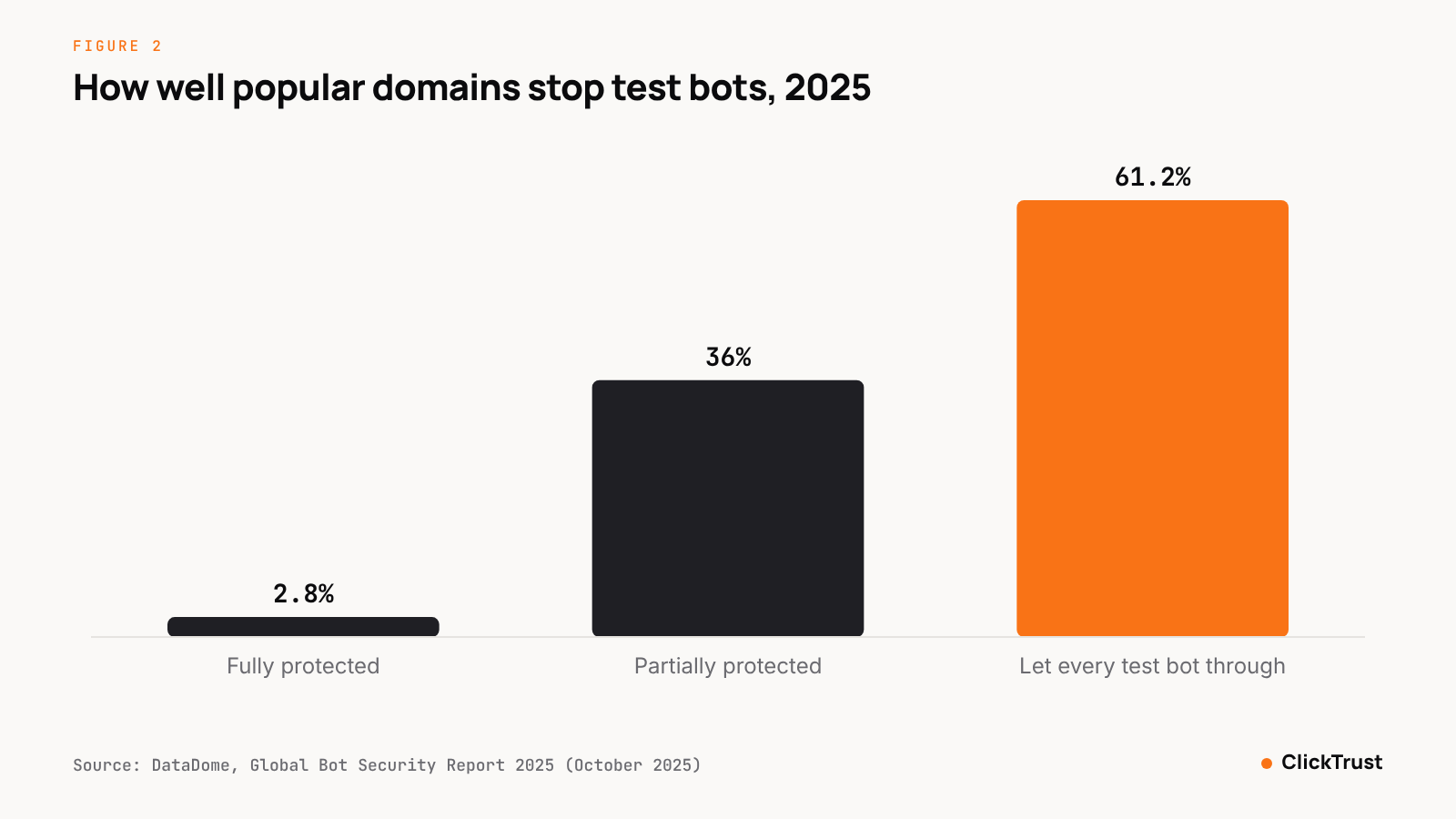 Figure 2. Share of about 17,000 popular domains that were fully protected, partially protected or unprotected against test bots in 2025, from DataDome's Global Bot Security Report 2025.
2. Incentivized form fills
Someone is paid a small sum, in cash, points or app rewards, to submit your form. The person is real and the data may even be real, but there is no interest in the offer. Incentivized fills pass most bot checks because a human is at the keyboard, which is why they fall into the class the MRC calls Sophisticated Invalid Traffic, identified "through advanced analytics, multipoint corroboration, human intervention" rather than list-based filters (MRC, Invalid Traffic Detection and Filtration Guidelines Addendum release, October 2015). The corroboration that catches them is downstream: contact rate, show-up rate and sales acceptance by source.
3. Affiliate lead fraud
When you pay per lead, an affiliate's income depends on volume, not quality. The weakest partners mix a few genuine leads with purchased lists, bot submissions and leads resold from other campaigns.
The clearest measurement of the incentive comes from app installs, where the same partners run the same playbook. AppsFlyer's The State of Fraud for Marketers, 2026 Edition (link) found affiliates generated about 40% of fraudulent installs at a roughly 40% fraud rate every quarter, against about 1% for self-reporting networks, a 36x gap in Q1 2026. In India, the affiliate share of install fraud grew from 57% to 65% year on year. The affiliate fraud detection guide covers partner-side controls in depth.
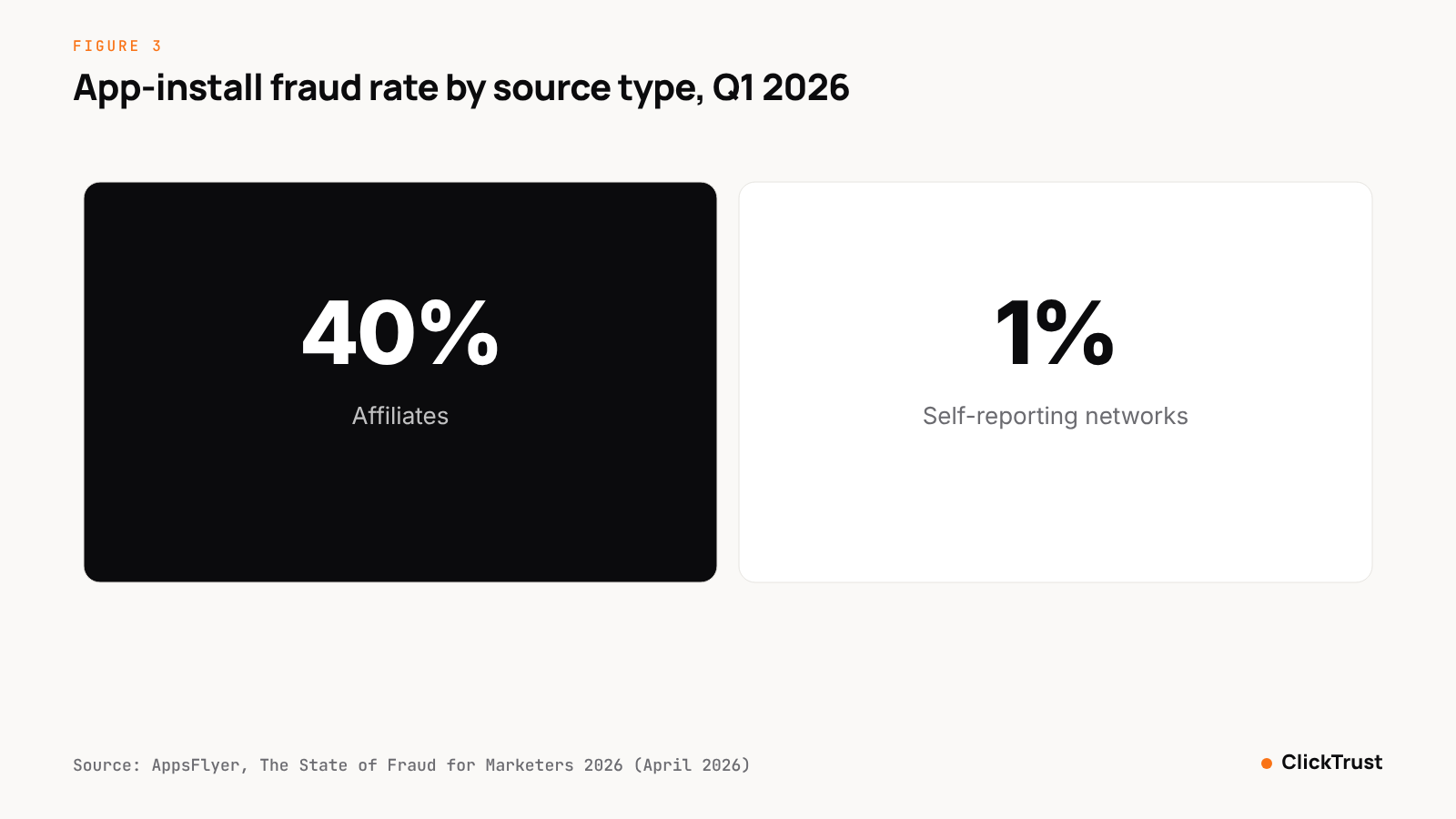 Figure 3. Install-fraud rate for affiliates against self-reporting networks in Q1 2026, from AppsFlyer's The State of Fraud for Marketers 2026; the same pay-per-outcome incentive drives affiliate lead fraud.
4. Recycled and fabricated data
The cheapest fake lead is an old real one. Contact records leak from breaches, from previous campaigns and from data brokers, then get replayed into new forms with a fresh timestamp. The lead looks valid to a basic validator because the email exists and the phone connects. Only when the sales rep calls does the person say they never asked about your product.
Fabricated identities are growing fastest in this region: Sumsub reported synthetic-personal-data fraud attacks in APAC surged 142% year on year to 15.7% of all fraud attempts (Sumsub, press release via AAP, November 2025). A synthetic identity built to pass KYC passes a lead form without effort.
What fake leads cost beyond the media bill
The click is the smallest part of the loss. The larger costs arrive later, in three places.
Sales time. Every fake lead gets dialed, emailed and followed up on the same cadence as a real one. Reps spend their best hours on contacts who will never answer, and the real prospects in the queue wait longer.
CRM pollution. Fake records inflate pipeline, distort lead scoring and damage email deliverability when campaigns bounce off invented addresses. Months later the same records surface in lookalike seeds and retargeting lists, so the fraud compounds.
Attribution and bidding. Google Ads, Meta and LinkedIn optimize toward whatever you report as a conversion. If a fifth of your leads are fake and you feed them back as conversions, Smart Bidding and Performance Max learn that the sources producing fakes are good and raise bids there. Removing fakes from the conversion feed is the only way to make the algorithm learn from real demand; The Signal's first episode, Why a low CAC can be a warning sign, walks through what that looks like in a founder's dashboard.
ClickTrust audits find that 14 to 42 percent of paid traffic is invalid depending on channel, so the share of leads that deserves scrutiny is rarely small.
Symptom, likely cause and what to check
| Symptom | Likely cause | Check |
|---|---|---|
| Lead spike with no change in spend or creative | Automated submission, or a new affiliate pushing volume | Submissions per IP and per network; time on page before submit |
| Leads arrive in bursts at regular intervals | Scripted submission | Plot timestamps to the second; bots cluster, humans scatter |
| Names and emails follow patterns (name plus digits, disposable domains) | Fabricated data | Domain and MX checks; disposable-provider lists |
| Phone numbers unreachable or VoIP | Recycled or fabricated data | Line type and carrier validation before routing to sales |
| High volume, near-zero sales acceptance from one source | Affiliate or placement fraud | Rank sources by sales-qualified rate, not lead count |
| Same contact submits across campaigns or brands | Recycled lists | Hash and deduplicate contacts across properties |
| Leads from regions you do not serve | Proxy or data-center traffic | Match IP location against targeting and the stated address |
| Form completed in a few seconds | Bot | Time from page load to submit, and from first keystroke to submit |
A 7-step protection plan against fake leads
- Add form-level checks that bots fail. Require JavaScript to render the submit action, verify that the form token was issued to the same session that submits it, and reject direct POSTs to the endpoint.
- Deploy honeypot fields. Add a hidden field that humans never see. Any submission that fills it is automated. Rotate the field name so scripts cannot learn to skip it.
- Measure timing. Record page load, first interaction and submit timestamps. Discard submissions that complete faster than a person can read the form, and hold submissions with no interaction events for review.
- Validate phone and email at submit time. Check email syntax, domain existence, MX records and disposable-provider lists. Check phone line type, carrier and country. Route failures to a review queue instead of to sales.
- Score every source, not just every lead. Track sales-accepted rate, contact rate and show-up rate by campaign, placement, publisher and affiliate. A source whose leads never convert downstream is invalid even when each lead passes validation.
- Sync exclusions back to the platforms. Push the IPs, placements and audiences that produce fake leads into Google Ads, Meta and Bing as exclusions, and refresh the list daily. Excluding one bad IP once does nothing; excluding bad sources continuously changes what the algorithm learns.
- Hold affiliate postbacks until leads are verified. Fire the conversion postback only after validation, and ideally after sales acceptance. Pay on verified leads with a reconciliation window, and give each partner its own fraud score. Click inflation stops being profitable when it cannot graduate to conversion manipulation.
What Google says about invalid leads
Google treats poor-quality leads as a form of invalid traffic and will review them on request. Google Ads Help says the Click Quality Form accepts investigation requests for "invalid clicks, poor-quality form submissions, clicks outside location targeting, or sudden short-term cost increases" (Google, About the Invalid Activity Credit Report, Google Ads Help). Requests cover activity within the last 60 days and typically take several business days, and you are not charged for invalid traffic detected before billing (Google, About invalid traffic, Google Ads Help).
Credits for activity caught after billing appear in the Invalid Activity Credit Report in Report Editor, broken down by campaign and network, per the same help page. On November 12, 2026, Google introduced an Invalid Traffic Overview Card in Google Ads that shows the amount saved by automated protection and the credits issued for past invalid activity, and said it had cut advertiser exposure to invalid leads by an average of 30% so far in 2026 (Google, We're introducing a new transparency tool for invalid traffic in Google Ads).
That is real progress, and it has a boundary: Google reviews only what passed through its own network, on the evidence you supply within 60 days. Incentivized fills, affiliate leads and recycled data arrive through channels Google never sees, so they need a layer you control, and the Google Ads refund checklist covers how to build the evidence for the ones it does.
How ClickTrust helps
ClickTrust scores every click and form event in under 50 milliseconds against 320 detection traps, each labelled GIVT or SIVT in line with MRC invalid-traffic guidance, and returns one Traffic Quality Index (TQI) per event. Web Protection runs as a JavaScript tag on your landing pages and pushes IP and audience exclusions to Google Ads, Meta and Bing automatically. Lite-MMP Attribution adds tracking links, server-to-server postbacks and a per-affiliate fraud score, so you can see each partner's lead quality before you pay for it. Refund-ready evidence packs support Click Quality Form requests. It is free to start.
Sources
- Google, Google Ad Traffic Quality (undated, fetched November 2026), https://www.google.com/ads/adtrafficquality/
- F5 Labs, 2025 Advanced Persistent Bots Report (March 28, 2025), https://www.f5.com/labs/articles/threat-intelligence/2025-advanced-persistent-bots-report
- Sumsub, Identity Fraud Report 2025-2026 (2025), https://sumsub.com/fraud-report-2025/
- Imperva, Bad Bot Report 2026: Bots in the Agentic Age (April 2026), https://www.imperva.com/blog/bad-bot-report-2026-bots-agentic-age/
- Arkose Labs, The State of Agentic AI Trust Report, Q3 2026, as reported by PPC Land, 97.7% of legitimate AI agent sessions carry no verified ID, Arkose finds (October 21, 2026), https://ppc.land/97-7-of-legitimate-ai-agent-sessions-carry-no-verified-id-arkose-finds/
- DataDome, Which Industries Are Most & Least Protected from Bad Bots & Unwanted AI Traffic in 2025? (Global Bot Security Report 2025, syndicated on Security Boulevard) (October 30, 2025), https://securityboulevard.com/2025/10/which-industries-are-most-least-protected-from-bad-bots-unwanted-ai-traffic-in-2025/
- Media Rating Council, Media Rating Council (MRC) Issues Final Version Of Invalid Traffic Detection And Filtration Guidelines Addendum (October 27, 2015), https://prnewswire.com/news-releases/media-rating-council-mrc-issues-final-version-of-invalid-traffic-detection-and-filtration-guidelines-addendum-300166843.html
- AppsFlyer, The State of Fraud for Marketers, 2026 Edition (April 2026), https://www.appsflyer.com/resources/reports/state-fraud-marketers-report/
- Sumsub, Annual Sumsub Report Reveals Synthetic Personal Data in APAC Soars 142% YoY Amidst Fraud Crackdowns (press release via AAP, November 25, 2025), https://www.aap.com.au/aapreleases/cision20251125ae32757
- Google, About the Invalid Activity Credit Report, Google Ads Help (2026, undated), https://support.google.com/google-ads/answer/16826168?hl=en
- Google, About invalid traffic, Google Ads Help (undated, fetched November 2026), https://support.google.com/google-ads/answer/11182074?hl=en
- Google, We're introducing a new transparency tool for invalid traffic in Google Ads (November 12, 2026), https://blog.google/products/ads-commerce/invalid-traffic-overview-google-ads/
Frequently asked questions
What are fake leads?
Fake leads are form submissions, calls or sign-ups that do not come from a real person with genuine interest in your offer. They are produced by automated scripts, by people paid to fill forms, by affiliates fabricating conversions to earn commission, or by replaying recycled contact data. They pass as leads in your CRM but never progress to a sale.
How do I know if my leads are fake?
Look for submissions that arrive in bursts, complete in a few seconds, share IP ranges or data-center origins, use disposable email domains or VoIP numbers, or come from locations you do not serve. Then rank each campaign, placement and affiliate by sales-accepted rate. A source with many leads and near-zero acceptance is producing fake leads even if each record looks plausible.
Why do lead-generation campaigns get more fake leads than e-commerce?
A purchase needs a payment card and a shipping address, which are hard to fake at scale. A lead only needs a name, an email and a phone number, all of which can be invented, bought or scraped. F5 Labs measured more than one in five add-to-cart transactions as automated even where a card is required at the next step; a form that asks for nothing verifiable is far easier to abuse.
Does Google refund fake leads?
Google Ads Help says the Click Quality Form accepts investigation requests for invalid clicks, poor-quality form submissions, clicks outside location targeting or sudden short-term cost increases, covering activity within the last 60 days, and reviews typically take several business days. In November 2026 Google said it had cut advertiser exposure to invalid leads by an average of 30% so far that year. Leads from affiliates, incentivized fills and recycled data sit outside that coverage.
What is a honeypot field on a lead form?
A honeypot is a form field hidden from human visitors with CSS, so a real person never fills it. Automated scripts read the form's HTML and populate every field, so any submission with the honeypot filled is flagged as a bot and discarded. Rotating the field name stops scripts from learning to skip it. It is a low-cost first layer, not a complete defense.
Should I pay affiliates per lead or per verified lead?
Pay per verified lead with a reconciliation window. Fire the conversion postback only after the submission has passed email, phone and source validation, and ideally after sales acceptance. AppsFlyer's State of Fraud for Marketers 2026 found affiliates ran at roughly a 40% install-fraud rate against about 1% for self-reporting networks, a 36x gap, and a held postback removes the payoff for the same behavior on lead forms.