Bot Clicks on Facebook Ads, TikTok and LinkedIn: 2026 Guide
ClickTrust Research · · 10 min read · bot clicks on Facebook ads · Meta ads · TikTok ads · LinkedIn ads · paid social · invalid traffic
TL;DR Meta actioned 1.1 billion fake accounts on Facebook in Q4 2025 alone, LinkedIn stopped 88.9 million at registration in the second half of 2025, and TikTok removed 86.3 million in the first quarter of 2026. Platform controls remove audiences and placements you already know are bad, but only a landing-page score can catch a bot click at the moment it happens.

Key takeaways
- Meta took action against 692 million fake accounts on Facebook in Q3 2025 and 1.1 billion in Q4 2025, and estimated fakes at 4% to 5% of daily active people, in its March 2026 filing with the EU.
- LinkedIn stopped 88.9 million fake accounts at registration between July and December 2025 and says 99.7% of fake accounts were stopped before a member report, per its Community Report.
- TikTok removed 86.3 million fake accounts between January and March 2026, 99.3% of them proactively, according to its Brand Protection Playbook.
- Juniper Research estimates nearly 1 trillion scam-ad impressions reached European social media users in 2025, around 10% of all social media advertising.
- TAG measured invalid traffic at about 1% in protected European channels against 10.36% in unfiltered video and display channels, a gap of more than 10x.
- ClickTrust audits find 14 to 42 percent of paid traffic is invalid depending on channel, so a platform's own fake-account share is the floor of your exposure, not the ceiling.
Bot clicks on Facebook ads, TikTok ads and LinkedIn ads cost more than most media teams assume, because paid social is measured on engagement and engagement is the easiest thing to fake. The platforms publish the scale themselves: Meta took action against 1.1 billion fake accounts on Facebook in the fourth quarter of 2025 alone, according to its March 2026 Code of Practice on Disinformation report (link). This post covers what each platform discloses, what industry bodies measure, how bot engagement distorts CTR, CPM and lookalikes, and what you can control in-platform.
Bot clicks on Facebook ads, and on any paid social placement, are ad interactions produced by automated accounts, scripts, click farms or compromised devices rather than by a person with genuine interest in the offer. Google's Ad Traffic Quality team applies the same test on its own network, defining invalid traffic as "any interaction that doesn't come from real people with real interest in an ad" (Google, Google Ad Traffic Quality).
How common are bot clicks on Facebook ads, TikTok and LinkedIn?
No platform publishes a per-click invalid rate for its ads, so the honest answer comes from three places: what the platforms disclose about fake accounts they catch, what industry bodies measure in protected and unprotected channels, and what an audit of your own landing page finds after the platform's filters ran.
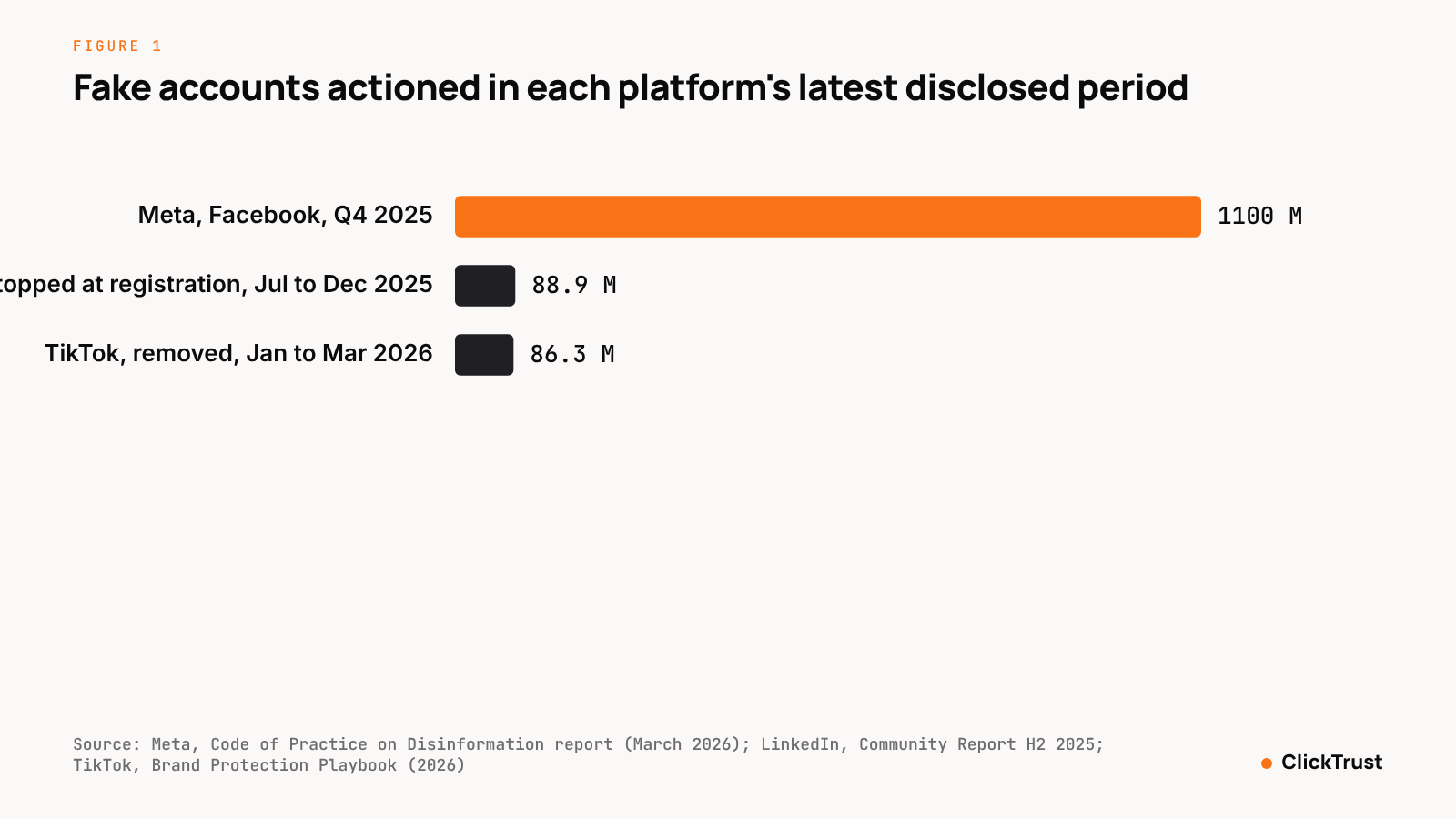 Figure 1. Fake accounts actioned in each platform's latest disclosed period, in millions, from Meta's March 2026 EU filing, LinkedIn's H2 2025 Community Report and TikTok's Brand Protection Playbook.
| Platform | Latest disclosed fake-account enforcement | Period | Source |
|---|---|---|---|
| Meta (Facebook) | 1.1 billion fake accounts actioned; fakes about 5% of daily active people | Q4 2025 | Meta, Code of Practice on Disinformation report, March 2026 |
| 88.9 million fake accounts stopped at registration, 24.4 million restricted proactively | Jul to Dec 2025 | LinkedIn, Community Report, H2 2025 | |
| TikTok | 86.3 million fake accounts removed, 99.3% proactively | Jan to Mar 2026 | TikTok, Brand Protection Playbook, 2026 |
| Google Ads | 8.3 billion ads blocked or removed, 24.9 million advertiser accounts suspended | 2025 | Google, 2025 Ads Safety Report, April 2026 |
Those are enforcement figures, not exposure figures: how many fakes the platform caught, not how many of your clicks came from fakes first.
Industry bodies measure the gap between filtered and unfiltered inventory. TAG's 2025 European Ad Fraud Savings Report (PDF) estimated an invalid traffic rate of 10.36% in unfiltered video and display channels in 2023 against about 1% in channels covered by TAG certification.
The wider web is the backdrop. Imperva's Bad Bot Report 2026 (link) found bots accounted for more than 53% of all web traffic in 2025, with 40% of bot traffic classified as malicious. Scam advertising on social platforms is part of the same economy: Juniper Research estimates nearly 1 trillion scam-ad impressions reached European social media users in 2025, around 10% of all social media advertising (Juniper Research, The Distillery #22, February 2026).
What reaches you is the third measure: ClickTrust audits find 14 to 42 percent of paid traffic is invalid depending on channel. A platform's own fake-account share is the floor of your exposure, because fake accounts exist to click.
Meta's own numbers on fake accounts
Meta publishes the scale itself, in reports filed under the EU Code of Practice on Disinformation. In its September 2025 report (link), Meta said it took action against 1 billion fake accounts on Facebook in Q1 2025 and 687 million in Q2 2025, and that fake accounts represented approximately 3% of worldwide monthly active users in Q1 and 4% in Q2.
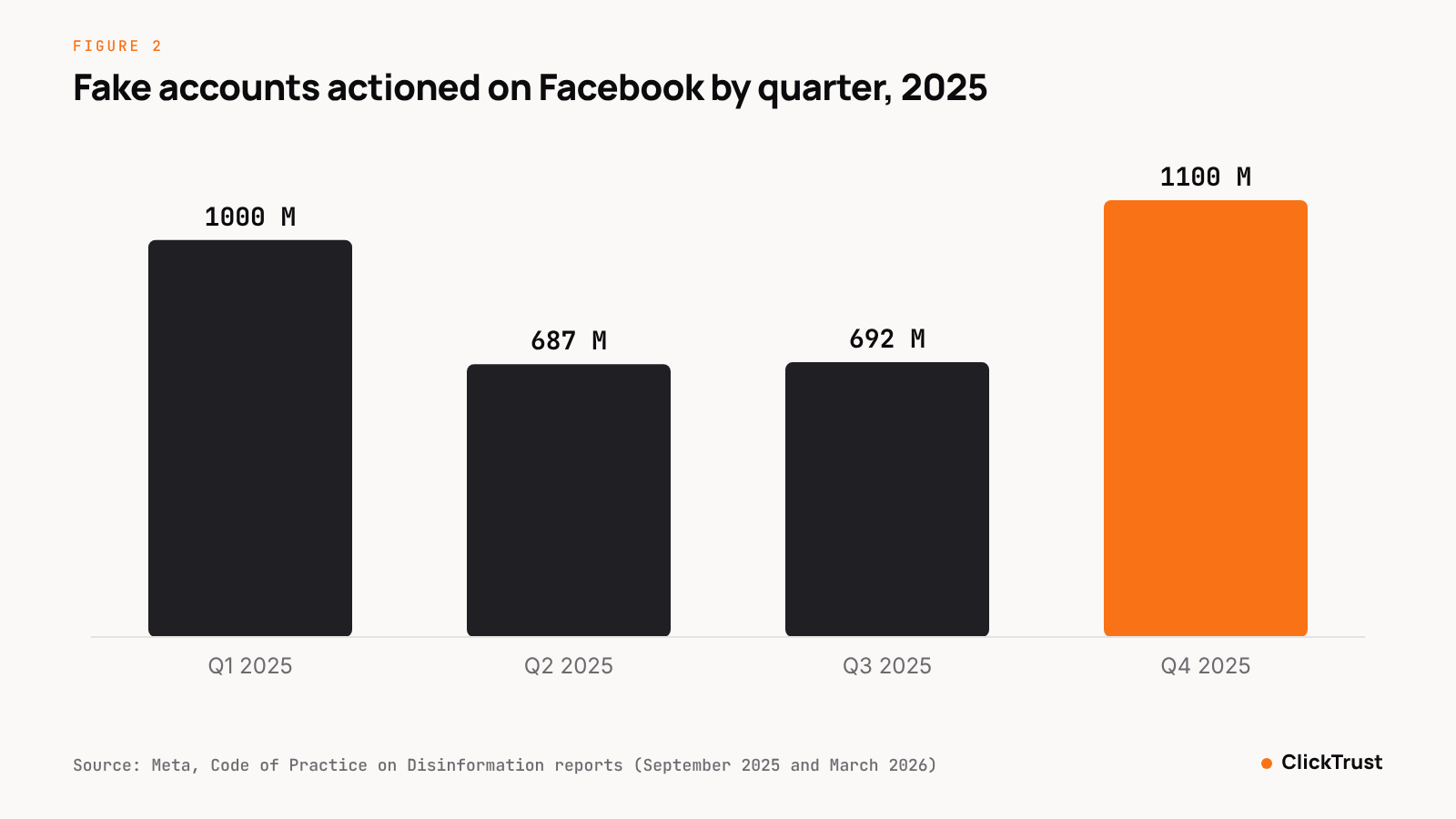 Figure 2. Fake accounts actioned on Facebook in each quarter of 2025, in millions, from Meta's Code of Practice on Disinformation reports of September 2025 and March 2026.
The March 2026 report (link) covers the second half of the year: 692 million fake accounts actioned in Q3 2025 and 1.1 billion in Q4 2025, with fakes estimated at about 4% of worldwide daily active people on Facebook in Q3 and 5% in Q4. The second-half figures are stated against daily active people rather than monthly active users, so the two halves are not strictly comparable. In its Integrity Reports, H1 2026 (link), Meta said it removed over 159 million scam ads in 2025, 92% of them before anyone reported them.
Read these numbers as a rate of supply: roughly one account in twenty on Facebook was fake at the end of 2025 by Meta's own estimate, and the quarterly count does not fall because caught accounts are replaced.
What LinkedIn and TikTok disclose
LinkedIn reports in its Community Report (link) that it stopped 88.9 million fake accounts at registration between July and December 2025, and restricted a further 24.4 million proactively before any member report. LinkedIn says 99.7% of fake accounts were stopped proactively.
TikTok's Brand Protection Playbook (PDF) reports 86.3 million fake accounts removed globally between January and March 2026, with 99.3% of removals proactive and 94.4% within 24 hours.
High proactive rates are good news, and they leave the same gap. A fake account stopped at registration never clicks your ad; one that survives a day on TikTok or a week on LinkedIn can click dozens of ads before it is caught, and those clicks are billed.
Why social CPMs attract bot engagement
Paid social is sold on reach and optimized on engagement, so a fake account earns money for someone whenever it clicks, likes or watches. Three structures make it attractive.
Engagement farms. Accounts are created in bulk, aged with ordinary activity to pass platform checks, then rented out to like, comment on and click content. When one lands in your ad's audience, every click is a cost to you and a signal to the platform that your ad is performing.
Incentivized engagement and reward apps. Some apps pay users small sums to interact with ads and content. The person is real; the interest is not. A human is at the keyboard and the device is genuine, which is why the MRC reserves the Sophisticated Invalid Traffic category for cases that need "advanced analytics, multipoint corroboration, human intervention" (MRC, Invalid Traffic Detection and Filtration Guidelines Addendum release, October 2015).
Competitors and arbitrage. Social ads are cheap to click repeatedly and budgets are daily, so a rival can exhaust yours by mid-morning. Google Ads Help lists "manual clicks" that raise your costs or inflate publisher profits as one of its three types of invalid click (Google, Invalid clicks: Definition, Google Ads Help); the same two motives apply on social.
How bot clicks distort CTR, CPM and lookalike audiences
The damage goes beyond the clicks you paid for, because social platforms use engagement to decide what to show next and to whom.
CTR and CPM. Bot clicks inflate click-through rate, which looks like a win in the dashboard. But the auction rewards engagement with lower CPMs and wider delivery, so an ad that bots like gets more budget, the algorithm expands delivery to similar accounts, which means similar bots, and your effective CPM for humans rises even as the reported CPM falls.
Lookalike and Advantage+ audiences. Lookalikes are seeded from your converters and engagers. If the seed contains bots, the model learns to find more bots. This is the most durable form of damage because it persists in every campaign that reuses the seed. The same mechanism applies to TikTok's Smart Performance Campaigns and LinkedIn's predictive audiences.
Retargeting. Bot accounts that clicked once enter your retargeting pools and get served again. You pay a second time for an account that was never a person. The Signal's low-CAC episode shows how this reads as a cheap, hollow funnel.
Platform-side controls versus an external score
Meta, TikTok and LinkedIn each offer controls that reduce exposure to bot clicks. None of them identifies a bot for you at the moment of the click.
| Control | Meta | TikTok | What it does and does not do | |
|---|---|---|---|---|
| Audience exclusions (custom audiences, uploaded lists) | Yes | Yes | Yes | Excludes accounts you already know are bad; does not find new ones |
| Placement controls (Audience Network, Pangle, LinkedIn Audience Network) | Yes | Yes | Yes | Removes the riskiest third-party inventory; does not touch in-feed bots |
| Engagement filters (comment moderation, blocked words) | Yes | Yes | Limited | Cleans the page; does not stop clicks being billed |
| Conversion-event controls (which events you upload) | Yes | Yes | Yes | Keeps fakes out of the learning signal only if you verify first |
| Brand safety and inventory filters | Yes | Yes | Yes | Controls where ads appear, not who clicks |
| Per-click fraud score at the landing page | No | No | No | Needs an external tag that sees the session after the click |
The gap is the last row. The platform sees the account; you see the session. Only a landing-page layer can observe whether a click came from a real browser with real interaction, and only you can feed that back.
The industry-level evidence that layered filtering works is TAG's. Its European analysis found the roughly 24% of 2023 spend still running through unprotected channels likely sustained invalid-traffic losses of 1.19 billion euros, "more than 10x the relative level" of losses in protected channels (TAG, 2025 European Ad Fraud Savings Report). The data is from 2023 and covers video and display rather than social feeds, but a ten-fold gap between filtered and unfiltered inventory is what an independent layer on paid social buys you.
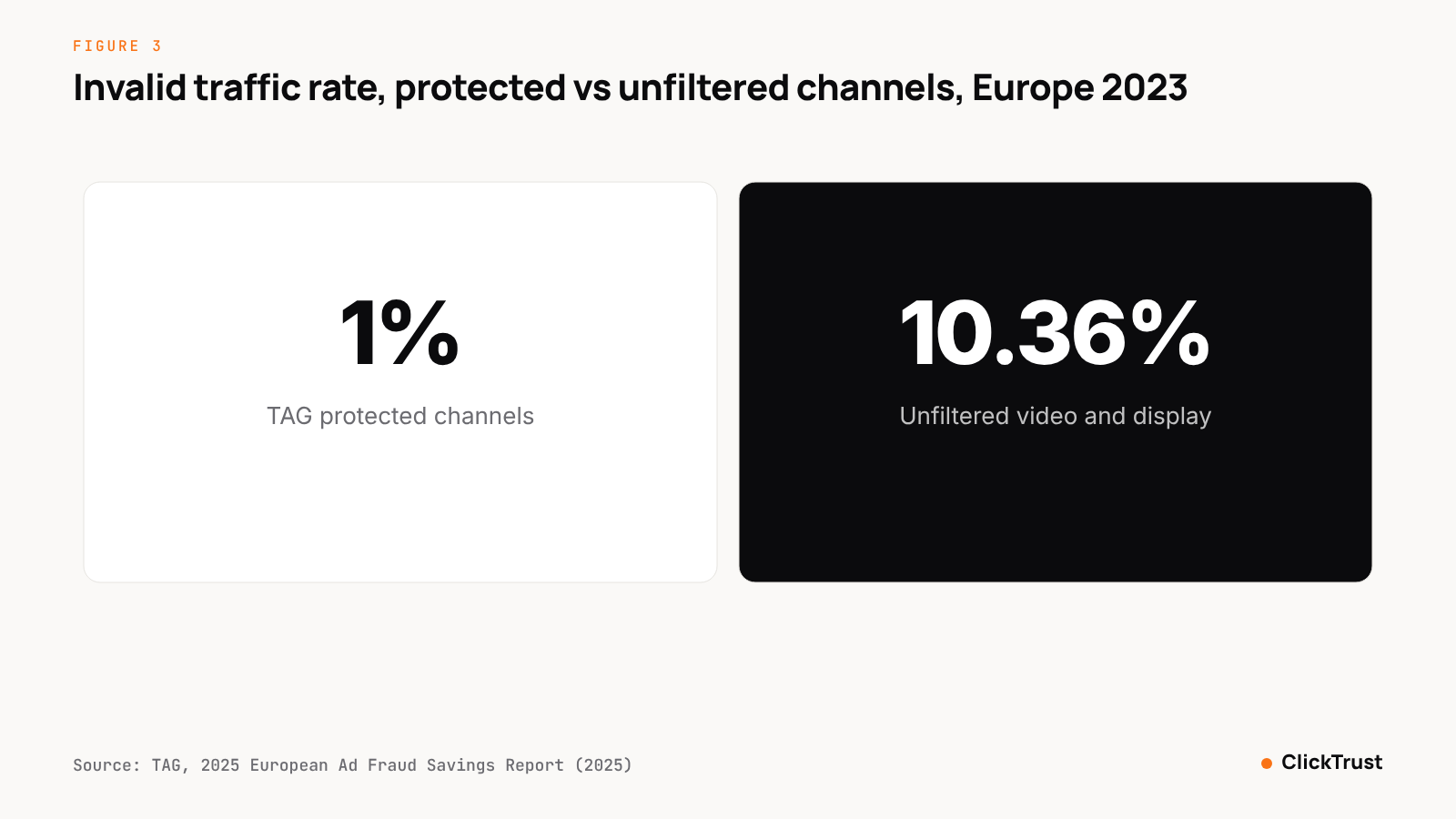 Figure 3. Invalid traffic rate in TAG-protected channels against unfiltered video and display channels in Europe, 2023 data, from TAG's 2025 European Ad Fraud Savings Report.
See the full platform pages for Meta, TikTok and LinkedIn.
Per-platform checklist
Meta (Facebook and Instagram)
- Exclude Audience Network placements for conversion campaigns unless you have placement-level proof that they convert.
- Seed lookalikes from verified converters only, never from engagers or from all leads.
- Upload invalid IP and account lists as exclusion audiences and refresh them weekly.
- Compare the invalid activity Meta reports on your account with your own flagged click count, and keep the evidence.
TikTok
- Measure your own invalid rate before assuming you are clean; TikTok removed 86.3 million fake accounts in a single quarter, and the survivors were clicking.
- Separate Pangle and in-feed placements in reporting, and exclude Pangle from lead campaigns.
- Track time from click to first interaction; clicks that never render the page are the first thing to cut.
- Hold conversion-event uploads until leads are verified so Smart Performance Campaigns do not learn from fakes.
- Assume lead-gen exposure: most LinkedIn budgets are lead-gen, and LinkedIn stopped 88.9 million fake accounts at registration in six months; the ones that got through are in your audience.
- Validate Lead Gen Form submissions (email domain, phone line type, company match) before they reach sales; the fake leads guide covers the checks.
- Exclude the LinkedIn Audience Network for anything but awareness.
- Score by campaign and job-title segment; bots cluster in a few segments.
Everywhere
- Put one tag on every landing page so all three platforms are scored by the same rules, and compare them on verified conversions rather than reported CTR.
- Push flagged IPs and audiences back to each platform as exclusions on a schedule, not once.
- Keep per-click evidence so a dispute rests on your logs, not a hunch.
How ClickTrust helps
Web Protection is a JavaScript tag that scores every click in under 50 milliseconds against 320 detection traps, each labelled GIVT or SIVT in line with MRC invalid-traffic guidance, and assigns one Traffic Quality Index (TQI) per event. It pushes IP and audience exclusions to Google Ads, Meta and Bing automatically; for TikTok and LinkedIn, apply the flagged lists through each platform's own exclusion tools. Refund-ready evidence packs back up disputes. ClickTrust audits find 14 to 42 percent of paid traffic is invalid depending on channel. It is free to start, and Traffic Rx gives a free diagnosis of a landing page's traffic.
Sources
- Meta, Code of Practice on Disinformation report, March 2026 (EU Transparency Centre) (March 2026), https://www.disinfocode.eu/reports/meta/8
- Google, Google Ad Traffic Quality (undated, fetched November 2026), https://www.google.com/ads/adtrafficquality/
- Meta, Report September 2025 (Code of Practice on Disinformation, EU Transparency Centre) (September 2025), https://www.disinfocode.eu/reports/meta/6
- Meta, Integrity Reports, H1 2026 (March 2026), https://transparency.meta.com/reports/integrity-reports-h1-2026/
- LinkedIn, Community Report (H2 2025 edition), https://about.linkedin.com/transparency/community-report
- TikTok, Brand Protection Playbook (2026), https://ads.tiktok.com/business/library/TikTok_Brand_Protection_Playbook.pdf
- Google, 2025 Ads Safety Report (April 2026), https://services.google.com/fh/files/blogs/global_2025_adssafetyreport.pdf
- TAG, 2025 European Ad Fraud Savings Report (2025), https://ppc.land/content/files/2025/06/2025_TAG_EuropeanFraudSavingsReport-Final-compressed.pdf
- Imperva, Bad Bot Report 2026: Bots in the Agentic Age (April 2026), https://www.imperva.com/blog/bad-bot-report-2026-bots-agentic-age/
- Juniper Research, The Distillery #22: Network APIs Go Agentic & Inside the Scam Social Media Ads Surge (February 2026), https://www.juniperresearch.com/resources/blog/the-distillery-22-network-apis-go-agentic-inside-the-scam-social-media-ads-surge/
- Media Rating Council, Media Rating Council (MRC) Issues Final Version Of Invalid Traffic Detection And Filtration Guidelines Addendum (October 27, 2015), https://prnewswire.com/news-releases/media-rating-council-mrc-issues-final-version-of-invalid-traffic-detection-and-filtration-guidelines-addendum-300166843.html
- Google, Invalid clicks: Definition, Google Ads Help (undated, fetched November 2026), https://support.google.com/google-ads/answer/42995
Frequently asked questions
How many clicks on Facebook ads are bots?
No platform publishes a per-click bot rate. In its March 2026 filing with the EU, Meta estimated fake accounts at about 4% of daily active people on Facebook in Q3 2025 and 5% in Q4 2025. That is a share of accounts, not clicks, and fake accounts click more than real ones because clicking is what they exist to do. ClickTrust audits find 14 to 42 percent of paid traffic invalid depending on channel.
Which social platform has the most bot clicks?
There is no independent cross-platform click benchmark from a non-vendor source, so compare platforms on your own verified-conversion rate rather than on reported CTR. What the platforms disclose is enforcement volume: Meta actioned 1.1 billion fake accounts in Q4 2025, LinkedIn stopped 88.9 million at registration in H2 2025 and TikTok removed 86.3 million in Q1 2026. Each number reflects platform size and detection effort as much as risk.
Does Meta refund invalid clicks?
Meta, TikTok and LinkedIn each handle invalid activity on their own terms and detect it with their own systems; Meta reports the scale of its enforcement in its Integrity Reports, including 159 million scam ads removed in 2025. None of the three gives you a per-click fraud score at the landing page, so clicks the platform does not classify as invalid are billed. Your own evidence is what supports a dispute.
How do bot clicks affect lookalike audiences?
Lookalike and Advantage+ audiences are modeled from your seed lists of converters and engagers. If bots are in the seed, the model learns to find accounts that behave like bots and expands delivery to them. This is the most durable form of damage from bot clicks because it persists in every campaign that reuses the seed. Seed lookalikes from verified converters only.
Can I block bot clicks inside Meta Ads Manager?
Partly. You can exclude uploaded custom audiences, remove Audience Network placements, moderate engagement and control which conversion events you upload. These controls remove audiences and placements you already know are bad. They cannot identify a new bot at the moment of the click, which requires a tag on the landing page that scores the session and feeds exclusions back.
Are fake accounts a problem for TikTok ads?
Yes, at scale. TikTok's Brand Protection Playbook reports 86.3 million fake accounts removed globally between January and March 2026, with 99.3% of removals proactive and 94.4% within 24 hours. Short-form video placements generate very high click volumes at low cost per click, so the accounts that survive detection can click a lot before they are caught. Separate in-feed from Pangle placements in reporting and score each on verified conversions.